Our memories shape who we are. They allow us to recognize loved ones, learn new skills, avoid danger, and build knowledge throughout our lives. Yet almost everyone has experienced the frustration of forgetting a name, misplacing keys, or walking into a room and forgetting why.
Contrary to popular belief, forgetting is not always a sign that something is wrong. In fact, it is a normal and essential part of how the brain functions. The brain constantly decides which information is worth keeping and which can safely be discarded.
How Memories Are Formed
Memory formation occurs in several stages:
1. Encoding Information from our senses enters the brain. Attention is essential because information that is ignored rarely becomes a memory.
2. Short-Term Memory The information is temporarily stored for seconds to minutes. Without rehearsal or importance, it quickly disappears.
3. Consolidation The brain strengthens the memory through repeated activation. During this stage, the hippocampus works closely with the cerebral cortex to organize and store information.
4. Long-Term Memory Once consolidated, memories become distributed across networks throughout the cerebral cortex, where they can remain for years or even a lifetime.
The Brain Structures Involved:
Several regions of the brain work together to create memories.
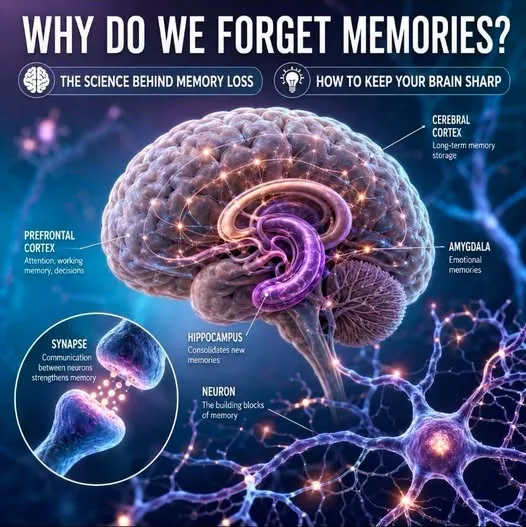
Hippocampus The hippocampus acts as the brain's memory librarian. It organizes and consolidates new memories before they are permanently stored.
Prefrontal Cortex Responsible for attention, planning, working memory, and retrieving stored information.
Amygdala Adds emotional significance to memories. Emotional experiences are often remembered more vividly because this region enhances memory formation.
Cerebral Cortex Stores long-term memories across different specialized areas depending on whether the memory is visual, auditory, motor, or emotional.
Why We Forget:
Forgetting usually happens because memory pathways gradually weaken.
Weak Memory Consolidation:
If information is never fully consolidated, it simply fades away before becoming permanent.
Lack of Repetition:
Neural pathways strengthen through repeated use.
Just as muscles become stronger with exercise, neurons become stronger with repeated activation.
The saying "use it or lose it" applies remarkably well to memory.
Synaptic Weakening:
Connections between neurons, called synapses, constantly change.
Frequently used synapses become stronger through:
• Long-Term Potentiation (LTP) • Increased AMPA receptor activity • Greater dendritic spine density • Improved communication between neurons
Unused synapses undergo:
• Long-Term Depression (LTD) • Reduced receptor activity • Smaller dendritic spines • Weaker communication
This makes memories increasingly difficult to retrieve.
Memory Interference:
New information can interfere with older memories.
Examples include:
• Learning a new password and forgetting the old one. • Moving house and forgetting the previous address. • Learning multiple languages that temporarily interfere with one another.
The Importance of Sleep:
Sleep is one of the most powerful memory enhancers.
During deep sleep the brain:
• Replays newly learned information. • Strengthens neural connections. • Removes unnecessary information. • Transfers memories into long-term storage.
Poor sleep has been linked to:
• Poor concentration • Reduced learning • Faster forgetting • Increased risk of dementia later in life
The Synapse: Where Memory Lives.
Memory depends on communication between neurons.
Important neurotransmitters include:
Glutamate The brain's primary excitatory neurotransmitter.
NMDA Receptors Help initiate long-term memory formation by allowing calcium to enter neurons.
AMPA Receptors Strengthen synaptic transmission and are essential for learning and memory.
Healthy synapses require:
• ATP (cellular energy) • Healthy mitochondria • Astrocytes for metabolic support • Microglia to remove damaged cells and maintain brain health
Why Recalling Memories Makes Them Stronger:
Interestingly, every time you remember something, that memory briefly becomes unstable.
The brain then "re-saves" it through a process called reconsolidation.
This allows memories to:
• Become stronger. • Be updated with new information. • Occasionally become slightly altered.
This explains why eyewitness testimony can sometimes become less accurate over time.
Factors That Can Impair Memory:
Many lifestyle and medical conditions affect memory.
These include:
• Chronic stress • Depression • Anxiety • Vitamin B12 deficiency • Vitamin D deficiency • Omega-3 deficiency • Iron deficiency • Thyroid disorders • Diabetes • Obesity • High blood pressure • Alcohol misuse • Smoking • Head injuries • Sleep disorders • Chronic inflammation • Certain medications • Neurodegenerative diseases such as Alzheimer's disease
How to Improve Memory Naturally:
While no single strategy guarantees perfect memory, research supports several habits that promote brain health.
Exercise regularly Aerobic exercise increases blood flow to the brain and stimulates the production of brain-derived neurotrophic factor (BDNF), a protein that supports neuron growth.
Sleep 7 to 9 hours Quality sleep is one of the strongest predictors of healthy memory.
Challenge your brain Learn a language, solve puzzles, play a musical instrument, or develop new skills.
Repeat information Spaced repetition helps reinforce neural pathways.
Eat a brain-healthy diet Include: • Leafy green vegetables • Berries • Nuts • Seeds • Oily fish or algae-derived omega-3s • Extra virgin olive oil • Whole grains
Stay socially active Meaningful conversations and social engagement stimulate multiple areas of the brain.
Manage stress Meditation, mindfulness, breathing exercises, and spending time in nature can reduce cortisol, a hormone that can impair memory when chronically elevated.
When Should Memory Loss Be Investigated?
Occasional forgetfulness is normal.
However, medical assessment is recommended if memory loss:
• Rapidly worsens. • Interferes with daily life. • Causes difficulty recognizing familiar people or places. • Is accompanied by personality changes. • Follows a head injury. • Is associated with confusion or difficulty speaking.
Early diagnosis can identify treatable causes and improve outcomes.
Final Thoughts:
Forgetting is not simply memory disappearing. It is often the result of weakened neural connections, insufficient rehearsal, interference from newer memories, or inadequate sleep. Fortunately, the brain remains remarkably adaptable throughout life. Every conversation, every new skill, every good night's sleep, and every healthy lifestyle choice helps strengthen the neural networks that preserve our memories.
By understanding how memory works, we can take practical steps to support lifelong learning, cognitive resilience, and healthy brain ageing.
Feel free to share this article without making any changes or additions.