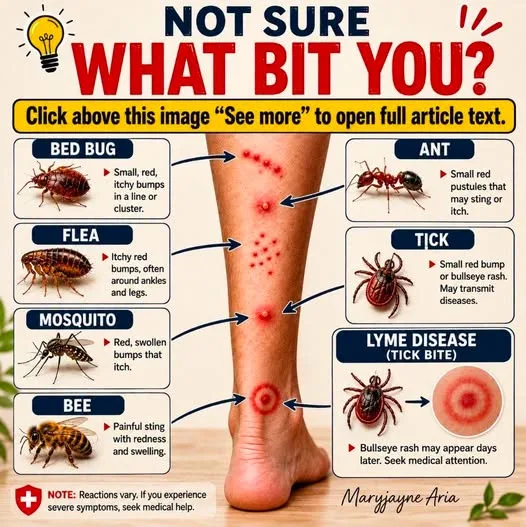
A bite or sting can sometimes offer clues about what caused it, but skin reactions are not fingerprints. Different insects and arthropods can produce very similar redness, swelling, itching and bumps, while the same bite can look dramatically different from one person to another.
The pattern, location, timing and symptoms surrounding the bite are often more useful than appearance alone. This guide explains some of the common patterns shown in the infographic, with special attention to ticks because certain species can transmit Lyme disease.
Bed bugs: Often appear in lines or clusters: Bed bug bites may produce small, itchy, red or swollen areas. In some people, bites appear randomly, while in others they may form a line or cluster. Reactions can also be delayed, meaning a person may not immediately connect the marks with an overnight exposure. Bed bugs are not known to transmit disease to people, but intense itching and scratching can damage the skin and occasionally contribute to secondary infection.
Fleas: Small, intensely itchy bites: Flea bites often cause small red bumps and can occur in clusters. They are frequently noticed on the feet, ankles and lower legs because fleas commonly jump from carpets, pets or other low-level environments onto the body. However, location alone cannot identify a flea bite. Mosquitoes, bed bugs and other biting insects can produce similar-looking lesions.
Mosquitoes: Raised, itchy bumps: Mosquito bites commonly produce raised, itchy bumps caused largely by the body's immune response to proteins in mosquito saliva. Some people develop only a small bump, while others develop more substantial swelling. The reaction can become more noticeable after scratching, and multiple mosquito bites can sometimes resemble other insect bites.
Ants: Bites, stings and pustules: Ant species vary considerably. Some ants bite, some sting, and some can cause small, painful or itchy pustules. Fire ant stings, for example, can produce characteristic sterile pustules after the initial sting. A rapidly spreading reaction, extensive swelling, breathing difficulty, dizziness or facial and throat swelling requires urgent medical attention.
Bees: Pain and local swelling: A bee sting is often immediately painful and may cause redness, swelling and tenderness around the sting site. In most people, the reaction remains local. The important distinction is between a typical local reaction and a systemic allergic reaction. Difficulty breathing, widespread hives, faintness, swelling of the tongue or throat, or rapidly worsening symptoms can indicate anaphylaxis and require emergency treatment.
Ticks: The bite itself may go unnoticed: Tick bites can be surprisingly easy to miss. Some ticks are very small, and their bites may cause little or no immediate discomfort. A small red bump at the bite site shortly after removal does not automatically mean Lyme disease. Ticks can transmit several infections depending on the species and geographic location. Lyme disease is associated with infected blacklegged ticks, also called Ixodes ticks, in regions where Lyme-causing Borrelia bacteria circulate.
The Lyme disease rash: The important clue is expansion: One of the most important features associated with early Lyme disease is erythema migrans, an expanding rash that can develop several days after an infected tick bite. According to the CDC, early symptoms may appear 3 to 30 days after the bite. The rash can become large and may sometimes develop central clearing, creating the familiar target or "bull's-eye" appearance. However, this is crucial: not every Lyme disease rash looks like a bull's-eye. Erythema migrans can appear as a solid expanding red lesion, an oval rash, or other patterns. It is also often not particularly itchy or painful.
Approximately 70 to 80 percent of people with Lyme disease develop erythema migrans, meaning the absence of a visible bull's-eye rash does not rule out infection.
Not every tick bite causes Lyme
disease: This is an important point when interpreting images online. A tick is not automatically a Lyme disease tick, and an immediate red mark at the site of a tick bite is often simply local irritation. Other conditions can also produce expanding or target-like rashes. Notes that some rashes resembling erythema migrans may have different causes, including Southern Tick-Associated Rash Illness, known as STARI. For this reason, a rash should not be diagnosed from a photograph alone.
What to watch for after a tick bite: Pay attention to an expanding rash and to symptoms such as: • Fever or chills • Headache • Unusual fatigue • Muscle or joint aches • Swollen lymph nodes • Facial weakness • New neurological symptoms • Palpitations or an irregular heartbeat • Significant joint pain or swelling. Early recognition and appropriate treatment of Lyme disease can help prevent more serious complications.
The bigger message: Patterns are clues, not diagnoses. The infographic is designed to help people notice patterns, but a bite cannot always be identified with certainty from appearance alone. A single red bump can result from an insect bite, irritation, allergy, infection, an inflamed hair follicle or numerous other causes.
The most useful information often includes: • Where the marks appeared • Whether they occurred indoors or outdoors • Whether pets are present • Whether the marks appeared overnight • Whether multiple people in the household are affected • Whether a tick was attached • Whether the rash is expanding • Whether fever or other systemic symptoms develo
The pattern on the skin is only one piece of the puzzle.
Please share this article without making changes to help others recognise important bite and sting patterns.