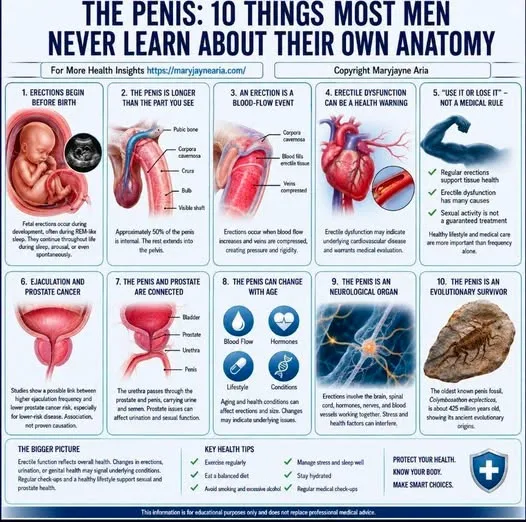
THE PENIS: 10 THINGS MOST MEN NEVER LEARN ABOUT THEIR OWN ANATOMY
Most men become familiar with their penis long before they learn anything about the biology behind it. It is there from birth, changes dramatically during puberty, responds to hormones, emotions, nerves and blood flow, and plays roles in urination, reproduction and sexual pleasure. Yet despite its familiarity, the penis is an extraordinarily complex organ. It is not simply an external appendage. A significant portion of its anatomy extends into the pelvis, where muscles, nerves, blood vessels and erectile tissues work together to produce an erection.
The penis can also sometimes act as an early warning system for problems occurring elsewhere in the body. So let's look beyond the jokes and explore 10 fascinating facts about male sexual anatomy, erectile function and prostate health.
1. ERECTIONS BEGIN BEFORE BIRTH
The penis does not wait until puberty to become functional. Erections can occur during fetal development, and ultrasound examinations have documented erections before birth. Research has associated fetal erections with periods of REM-like sleep. Their precise biological purpose isn't completely understood, but spontaneous erections appear to be part of normal neurological and vascular development. After birth, erections continue throughout childhood and adulthood. They can occur during sleep, on waking, in response to sexual stimulation, physical contact, or apparently for no obvious reason. Importantly, an erection does not necessarily mean a man is consciously sexually aroused. The erectile system can activate automatically.
2. THE PENIS IS LONGER THAN THE PART YOU CAN SEE
What you see externally is only part of the organ. The penis has a root that extends into the pelvis. The root contains the bulb and crura, which anchor the erectile tissues to surrounding structures. The visible shaft is therefore only one part of a much larger anatomical system. The commonly repeated statement that "half the penis is inside the body" has some anatomical basis, although the exact proportion depends on how the anatomy is measured.
3. AN ERECTION IS REALLY A BLOOD-FLOW EVENT
An erection isn't simply caused by sexual desire. It is primarily a vascular and neurological event. The penis contains two major erectile chambers called the corpora cavernosa. When appropriate nerves are activated, chemical signals cause smooth muscle and blood vessels to relax. Blood flows into the erectile spaces while venous outflow is restricted. The result is increased blood volume and pressure, producing rigidity. This is why erectile function is closely connected with cardiovascular health. High blood pressure, diabetes, smoking, obesity and vascular disease can all contribute to erectile dysfunction.
4. ERECTILE DYSFUNCTION CAN BE A HEALTH WARNING
An erection requires healthy blood vessels, functioning nerves, adequate hormonal signalling and intact erectile tissue. Persistent erectile dysfunction shouldn't automatically be dismissed as "just getting older." The arteries supplying the penis are relatively small, meaning vascular problems may sometimes become apparent through erectile changes before other cardiovascular symptoms appear. Not every episode of erectile difficulty indicates heart disease. Stress, anxiety, medication, hormonal changes, relationship difficulties and poor sleep can also interfere with erections. However, persistent or newly developing erectile dysfunction deserves medical attention.
5. "USE IT OR LOSE IT" HAS SOME BIOLOGICAL TRUTH, BUT IT IS NOT A MEDICAL RULE
The expression "use it or lose it" is often applied to erectile function. There is a biological reason the idea has persisted. Regular erections expose erectile tissues to cycles of oxygenation, blood flow, expansion and relaxation. Men also commonly experience spontaneous and sleep-related erections without consciously initiating them. However, medicine does not say that a man who stops having sex will automatically lose his penis or develop erectile dysfunction. Erectile dysfunction has many possible causes, including vascular disease, diabetes, neurological disorders, medications, psychological factors, hormonal problems, pelvic surgery and aging.
A man can have a healthy penis without sexual intercourse. The scientifically accurate message is simple: maintaining healthy erectile function matters, but sexual activity is not a guaranteed treatment for erectile dysfunction.
6. EJACULATION AND PROSTATE CANCER: AN INTERESTING CONNECTION
This is where the subject becomes particularly interesting. The prostate is a reproductive gland located below the bladder and surrounding part of the urethra. It contributes fluid to semen. Researchers have investigated whether ejaculation frequency might influence prostate health. One large study involving 31,925 men found that men reporting higher ejaculation frequency were less likely to subsequently be diagnosed with prostate cancer, particularly lower-risk disease.
Earlier research similarly reported an association between higher ejaculation frequency and reduced prostate cancer risk. Men who ejaculate more frequently may differ from other men in exercise, diet, relationships, health status and healthcare use. Researchers have proposed several possible explanations, including the possibility that ejaculation helps clear prostate secretions or reduce exposure to potentially irritating substances.
The mechanism remains uncertain. Therefore, it would be inaccurate to say that "not using your penis causes prostate cancer." What the research does show is that sexual and reproductive biology has a relationship with prostate health that deserves further investigation.
7. THE PENIS AND PROSTATE ARE CONNECTED THROUGH THE URETHRA
The prostate and penis aren't isolated systems. The male urethra passes through the prostate and continues through the penis. It carries urine out of the body and carries semen during ejaculation. This shared pathway helps explain why prostate problems can affect both urination and sexual function.
An enlarged prostate can cause:
• Weak urine stream. • Increased urinary frequency. • Nighttime urination. • Difficulty starting urination. • Dribbling. • Incomplete bladder emptying. These symptoms should not simply be accepted as an inevitable part of aging. They deserve assessment.
8. THE PENIS CAN CHANGE WITH AGE
Aging doesn't necessarily mean erectile function has to disappear. However, the tissues and systems responsible for erections can change. Blood vessel health becomes increasingly important. Diabetes, hypertension, smoking, obesity and other conditions can damage circulation and contribute to erectile difficulties. Changes in testosterone, medications, pelvic surgery and conditions such as Peyronie's disease can also affect sexual function or penile appearance. A change in erectile function isn't necessarily "just age." Sometimes it is a clue that something else deserves investigation.
9. THE PENIS IS AN INCREDIBLY SENSITIVE NEUROLOGICAL ORGAN
Erections aren't controlled by the penis alone. The brain, spinal cord, autonomic nervous system and peripheral nerves all participate. The penis contains sensory nerves that communicate information back to the nervous system, while other nerves control the vascular changes necessary for erection. Pelvic muscles also contribute to erection and ejaculation.
This explains why:
• You can have sexual desire without an erection. • You can have an erection without consciously feeling sexually aroused. • You can lose an erection despite being mentally interested in sex. The brain and body have to cooperate. Stress, anxiety, fear, depression, poor sleep and relationship difficulties can interfere with this communication just as physical disease can.
10. THE PENIS IS AN EVOLUTIONARY SURVIVOR
The structures involved in male sexual reproduction are ancient. The oldest unequivocal fossil penis currently known comes from a tiny Silurian ostracod called Colymbosathon ecplecticos. The fossil is approximately 425 million years old and was preserved with remarkably detailed soft anatomy, including its copulatory organ. Its name has been translated as "amazing swimmer with a large penis." This tiny creature was living hundreds of millions of years before humans existed. And yet the basic reproductive challenge was already being solved: delivering sperm efficiently enough for reproduction to occur. Evolution has produced countless variations on that theme. The modern human penis is one of them.
THE BIGGER MESSAGE: PAY ATTENTION TO WHAT YOUR BODY IS TELLING YOU
Perhaps the most interesting thing about the penis isn't its size, shape or ability to become erect. It is what erectile function can tell us about the rest of the body.
An erection requires:
• Healthy blood vessels. • Adequate blood flow. • Functioning nerves. • Appropriate hormonal signalling. • Healthy erectile tissue. • Coordinated brain and spinal cord activity. • Functioning pelvic structures. Because so many systems are involved, persistent changes in erectile function deserve attention.
Likewise, urinary changes, pain, blood in urine or semen, penile lumps, sores, unusual discharge, sudden curvature, or persistent changes in sexual function should not simply be ignored.
WHAT ABOUT PROSTATE CANCER?
This is where the "use it or lose it" statement needs to be handled carefully. Several observational studies have found that more frequent ejaculation is associated with a lower likelihood of prostate cancer diagnosis, particularly lower-risk disease. Age, family history, genetics, lifestyle and other biological factors remain important components of prostate cancer risk. "Sexual and reproductive health are legitimate components of men's overall health, and the relationship between ejaculation and prostate health is scientifically interesting and worthy of further research."
THE TAKE-HOME MESSAGE
The penis is far more than an organ of reproduction. It is a vascular organ, a neurological organ, a urinary organ and a reproductive organ. Its performance depends upon systems throughout the body. Changes in erections, ejaculation, urination or genital appearance can sometimes provide valuable information about underlying health. The penis may be one of the most joked-about parts of the male body. Biologically, however, it is serious business. After hundreds of millions of years of evolutionary history, it remains a remarkable example of how blood vessels, nerves, hormones, muscles and reproductive biology work together.
A healthy sex life is not simply about reproduction or performance. For many men, it is also part of physical wellbeing, emotional wellbeing, intimacy and quality of life. Looking after the whole body is therefore also one of the best ways to look after sexual health.