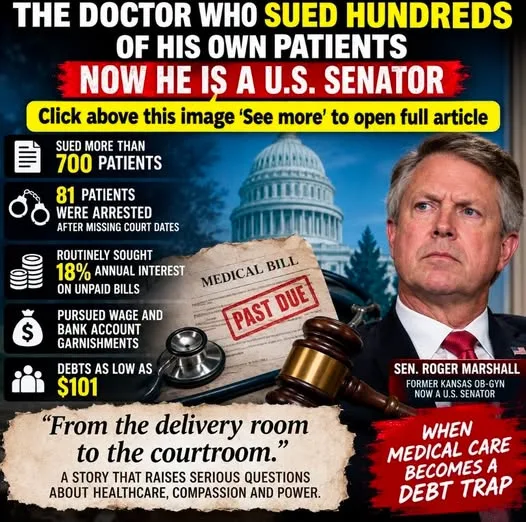
WHAT HAPPENS WHEN A DOCTOR BECOMES A DEBT COLLECTOR? A deeply disturbing investigation into the past medical career of U.S. Senator Roger Marshall of Kansas has raised serious questions about the treatment of patients who could not afford their medical bills. Before entering politics, Marshall spent more than two decades working as an obstetrician-gynecologist in rural Kansas. According to a New York Times analysis of Kansas court records, Marshall and the medical practice he owned or co-owned filed debt-collection lawsuits against more than 700 former patients. In 81 of those cases, patients were arrested after missing court dates connected to the debts. In at least 13 additional cases, his lawyers sought arrest warrants, although the records do not establish whether an arrest ultimately occurred.
THE NUMBERS ARE STUNNING: More than 700 patients found themselves on the other side of the legal system from a doctor who had previously treated them. The debts varied dramatically, ranging from several thousand dollars to amounts as low as $101. The practice also pursued wage and bank-account garnishments, while patient contracts routinely carried an 18 percent annual interest rate on unpaid balances. That interest rate could turn an already difficult medical bill into a financial burden that grew substantially over time.
THE PEOPLE BEHIND THE NUMBERS: These were not simply anonymous debtors. Many of the patients lived in rural Barton County, an area with relatively high poverty and uninsured rates. Some were new mothers dealing with the financial aftermath of pregnancy and childbirth. One patient, Meischa Zimmerman, was sued over a delivery bill of approximately $3,600. After falling behind on a payment arrangement, she was arrested multiple times in connection with the case. The Times reported that she recalled being arrested while pregnant and having to worry about the effect of the debt and arrests on her family.
A $4,561 BILL AND AN EASTER WEEKEND ARREST: One of the most shocking cases involved Joe Vasquez and his wife. Marshall had treated Vasquez's wife for an emergency hysterectomy, and the couple later faced a lawsuit over an unpaid bill of $4,561. After they missed a court date, Marshall's lawyers requested an arrest warrant. Police arrived at the couple's rural Kansas home over Easter weekend in 2007, while their grandchildren were preparing for an Easter egg hunt. The couple spent two days in custody before their son borrowed money to post bond. Vasquez told The Times, "We had no money to pay."
THE $101 QUESTION: Perhaps one of the most unsettling aspects of the investigation is the sheer range of the debts pursued through the courts. These were not exclusively enormous medical bills. The Times found cases involving debts as small as $101. When a medical practice takes a patient to court over an unpaid balance, adds substantial interest and then pursues legal enforcement when the patient fails to appear, the consequences can extend far beyond the original bill. What began as a healthcare debt could become a legal and financial crisis.
18 PERCENT INTEREST: The interest rate is another major part of the controversy. Patients were routinely charged 18 percent annual interest on unpaid balances. In some cases, that meant debts could grow dramatically when patients were unable to pay them quickly. One patient interviewed in the investigation said a roughly $3,600 medical debt eventually grew to more than $7,000. The practice's attorney confirmed that Marshall had approved the 18 percent interest rate, while maintaining that Marshall was not personally involved in individual decisions about warrants or garnishments.
WHO ASKED FOR THE ARRESTS? Marshall's defense has focused heavily on the argument that doctors do not personally issue arrest warrants. His spokeswoman said that judges issue warrants when people repeatedly miss court dates, not doctors. But the court records examined by The New York Times reportedly show that Marshall's lawyers repeatedly requested warrants, arguing in numerous filings that patients had failed to obey court orders. That distinction has become central to the controversy: the warrants were ultimately issued through the courts, but the records show that attorneys representing Marshall or his medical practice sought them.
MARSHALL'S RESPONSE: Marshall's spokeswoman has defended his record, saying he spent decades treating patients regardless of their ability to pay and that his former hospital provided millions of dollars in uncompensated care. His attorney, Steven Johnson, said Marshall was not involved in decisions regarding individual collection actions, warrants or garnishments, and characterized him as no different from other clients using legal remedies to collect debts. Marshall's representatives have therefore attempted to separate the senator from the day-to-day legal decisions made by his attorneys while acknowledging that he approved the 18 percent interest provision.
BUT THERE IS ANOTHER LAYER TO THIS STORY: Marshall is not simply a former doctor. He is now a United States senator, and his medical background remains a prominent part of his political identity. His campaign has promoted his experience as a physician and highlighted the thousands of babies he delivered during his career. That makes the revelations particularly uncomfortable because the same medical career that helped establish his public image as a trusted doctor is now being scrutinized through the experiences of hundreds of patients who ended up in debt-collection litigation.
THE TIMING MAKES IT EVEN MORE POLITICALLY EXPLOSIVE: The investigation comes as Marshall is seeking reelection. His political opponent has already seized on the findings, arguing that a senator who votes on healthcare policy should be held accountable for how his own medical practice treated patients who could not pay their bills. Marshall's supporters, meanwhile, argue that the investigation unfairly portrays a rural physician attempting to keep a medical practice operating in an environment where patients frequently struggled to pay.
WHEN HEALTHCARE MEETS DEBT COLLECTION: Medical debt is already one of the most emotionally and financially difficult forms of debt because it often begins with something nobody chooses: illness, pregnancy, an emergency or an operation. Patients do not generally walk into an emergency room knowing what the final bill will be, and people can find themselves owing money even when they have insurance. The Marshall investigation therefore raises a much larger question than the actions of one doctor: how far should healthcare providers be allowed to go when attempting to collect money from patients who cannot pay?
FROM HEALING ROOM TO COURTROOM: There is an extraordinary contradiction at the heart of this story. A doctor is entrusted with a patient's health at some of the most vulnerable moments of that person's life. Yet according to the court records reviewed by The New York Times, hundreds of people treated by Marshall or his practice subsequently faced lawsuits over medical debt, while dozens ultimately ended up arrested after missing court appearances. The legal system may have been involved in the arrests, but the records show that his attorneys were actively pursuing enforcement.
THE BIGGER QUESTION FOR VOTERS: Should a physician's approach to patients who cannot pay be considered part of that physician's public record when the doctor later becomes a politician responsible for shaping healthcare policy? Supporters may argue that medical practices have bills to pay and that unpaid debts cannot simply disappear. Critics will argue that aggressive collection tactics, 18 percent interest, wage and bank garnishments, and legal actions that resulted in arrests represent something profoundly different from simply asking a patient to pay a bill.
THIS IS NOT JUST ABOUT ROGER MARSHALL: It is about what happens when healthcare becomes inseparable from debt, and when an unpaid medical bill can follow a vulnerable patient from the doctor's office into the courtroom. It is about whether financial hardship should ever result in someone being handcuffed because they missed a court appearance over a medical debt. And ultimately, it is about the extraordinary contrast between the public image of the compassionate physician and the documented legal battles involving hundreds of former patients.
A DOCTOR, A DEBT COLLECTOR, AND NOW A SENATOR: Roger Marshall's defenders say the story is an unfair attack on a rural doctor who cared for thousands of patients. The investigation, however, documents a far more complicated history: more than 700 debt-collection lawsuits, 81 patients arrested after missing court dates, additional warrant requests, garnishments and an 18 percent annual interest rate. Those facts are now part of the public record. The question left for the public is not simply whether the debts were legitimate. It is whether the methods used to collect them were appropriate for someone whose profession was supposed to be healing the very people he later pursued through the courts.
Please share this information without making any changes to help increase awareness Copyright Maryjayne Aria author of Immume Health, Terrain and GcMaf