I HAVE A QUESTION FOR ANYONE WHO EATS DARK CHOCOLATE EVERY DAY: WHAT IF THE “HEALTHY” TREAT YOU HAVE BEEN TOLD TO ENJOY IS ALSO DELIVERING A DAILY DOSE OF HEAVY METALS?
Dark chocolate has been marketed for years as the sophisticated, healthier chocolate. Higher cocoa content, less sugar, antioxidants, flavanols, minerals and supposed benefits for cardiovascular health. It has become the chocolate many people deliberately choose because they believe they are making the healthier decision. But when I started looking at what has actually been found inside some of these products, I think the conversation becomes considerably more uncomfortable.
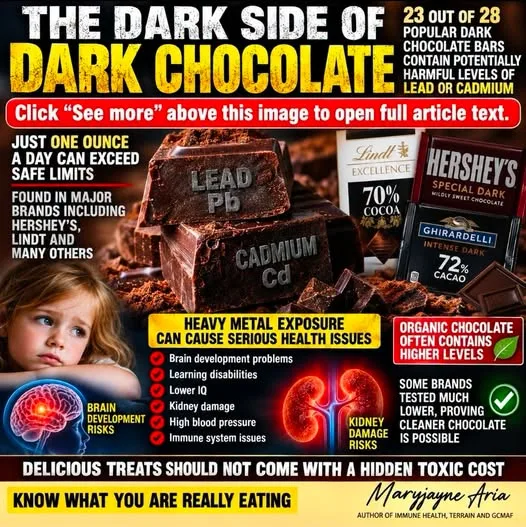
Consumer Reports tested 28 popular dark chocolate bars and detected lead and cadmium in every single one. In 23 of the 28 bars, approximately 82%, eating about one ounce a day would put an adult above the California Proposition 65 maximum allowable dose level for lead or cadmium used by Consumer Reports as its protective benchmark. Five products exceeded that benchmark for both metals. These were not obscure products nobody has heard of. The testing included major household names and widely available chocolate brands. There are no safe levels of lead or cadmium!
LEAD AND CADMIUM ARE NOT INGREDIENTS I EXPECT TO SEE IN A “HEALTHY” FOOD: Lead is a neurotoxic heavy metal and cadmium is a toxic metal that accumulates in the body. Consumer Reports notes that exposure to lead is been associated with nervous system problems, hypertension, immune suppression, kidney damage and reproductive problems. Children and pregnancy are particularly important populations because lead exposure interferes with brain and nervous system development.
WHAT MAKES THIS PARTICULARLY INTERESTING IS WHERE THE METALS ARE FOUND: The very cocoa solids responsible for much of dark chocolate's antioxidant reputation are also where heavy metals can accumulate. Cadmium is taken up from contaminated soil through the cacao plant. Lead appears to have additional routes into cocoa, including contamination of beans during harvesting, drying, transportation and processing. That means this is not simply a matter of adding something toxic to a chocolate recipe. The contamination enter the food chain before the chocolate bar ever reaches the factory.
AND THEN CAME THE LONGER TERM DATA HIDDEN: A 2024 peer reviewed study published in Frontiers in Nutrition examined 72 cocoa containing products purchased between 2014 and 2022. The researchers found that 31 of 72 products, or 43%, exceeded the California Proposition 65 maximum allowable daily level used for lead, while 13 of 37 products tested for cadmium, or 35%, exceeded the corresponding level. However the true fact is that there are NO safe levels!
THE ORGANIC LABEL DID NOT SOLVE THE PROBLEM: In fact, this is one of the findings that caught my attention. The 2024 study reported that "organic" products were statistically associated with higher concentrations of cadmium and lead in its analyses. Organic does not equate to pesticide spray free! It means the word “organic” by itself cannot be treated as a guarantee of heavy metal contamination. The study found no evidence that organic or other certifications consistently resulted in lower concentrations.
HERE IS WHERE THE STORY BECOMES EVEN MORE UNCOMFORTABLE: Consumer Reports subsequently tested additional chocolate products and again found detectable lead and cadmium across the products examined. In its 2023 testing, 16 of 48 products across several cocoa containing categories well exceeded its levels of concern for at least one of the metals. Dark chocolate generally had higher levels because it contains more cocoa solids, although cocoa powder, chocolate chips, baking products and other cocoa containing foods also contribute to exposure.
I AM NOT LOOKING AT ONE RANDOM CHOCOLATE BAR AND CLAIMING THAT EVERYONE WHO EATS IT IS BEING POISONED. THAT IS NOT WHAT THE DATA SHOW: What the data do show is something much more interesting and, in my opinion, much more worthy of public attention. Contamination varies dramatically between products. Some chocolate bars tested by Consumer Reports were well below its benchmark for both lead and cadmium, demonstrating that manufacturers can produce chocolate with substantially lower concentrations. The problem is therefore not simply “chocolate contains heavy metals.” The problem is that the amount can vary enormously depending on the product.
THAT SHOULD CHANGE THE QUESTION WE ASK: Instead of asking whether dark chocolate is healthy or unhealthy, I think consumers should be asking how much cocoa they are consuming, how frequently they are consuming it and whether the particular product has ever been independently tested for heavy metals. A food can contain beneficial compounds and undesirable contaminants at the same time. Nutrition is rarely as simple as putting a “healthy” label on one side and an “unhealthy” label on the other.
THE DAILY HABIT IS WHAT INTERESTS ME MOST: One occasional square of chocolate is not the same exposure pattern as eating a large amount of the same high contamination product every day. The 2024 researchers specifically noted that exposure can accumulate when people consume higher contamination products, consume more than one serving, or obtain heavy metals from multiple dietary sources. But no level is safe.
AND THIS IS WHERE I THINK CONSUMERS DESERVE FAR MORE TRANSPARENCY: We routinely scrutinise sugar, calories, artificial sweeteners, pesticides and additives, yet heavy metal contamination is something most people would never think to investigate when standing in front of a chocolate shelf. The packaging can proudly advertise cocoa percentage, organic certification, antioxidants and ethical sourcing, while the consumer has no simple way of knowing whether that particular batch contains elevated lead or cadmium.
I HAVE ALWAYS BELIEVED THAT THE FIRST STEP IN HEALTH IS KNOWING WHAT YOU ARE ACTUALLY PUTTING INTO YOUR BODY: This is not an argument that everyone must throw their chocolate into the bin. It is an argument for testing, transparency and informed choices. Consumer Reports found five bars in its original 28 bar investigation that remained below its levels of concern for both metals, demonstrating that lower contamination is achievable. Lower levels are not safe levels.
Several popular chocolate products have been found to contain unsafe levels of lead and cadmium, including brands tested by Consumer Reports such as Hershey’s, Ghirardelli, Lindt, Trader Joe’s, Theo, Hu, and Green & Black’s. In its testing, many products exceeded California Proposition 65 benchmarks for one or both metals, while others remained below those levels but no levels are safe!.
SO THE NEXT TIME YOU PICK UP A BAR OF DARK CHOCOLATE BECAUSE YOU HAVE BEEN TOLD IT IS THE “HEALTHIER” CHOICE, I WANT YOU TO STOP FOR A MOMENT AND ASK A DIFFERENT QUESTION: HAS THIS PRODUCT ACTUALLY BEEN TESTED FOR HEAVY METALS?
Because cocoa may contain antioxidants, but that does not magically make lead or cadmium beneficial. It makes it unsafe for consumption.
And perhaps the biggest lesson here is one I repeat constantly in my own research: never confuse marketing with evidence. “Dark,” “organic,” “premium,” “natural” and “high cocoa” are descriptions. They are not laboratory results.
That distinction matters.
Author of Immune Health, Terrain and GcMAF
Please share this information without making any changes to help increase awareness. Copyright Maryjayne Aria author of Immune Health, Terrain and GcMAF