Toxic Jewellery Scandal: Could the Ring on Your Finger Be Exposing You to a Cancer-Causing Metal?
Millions of people purchase jewellery online every year, trusting that labels such as "925 Sterling Silver" accurately describe what they are buying. A recent investigation has raised serious concerns that some inexpensive jewellery sold through online marketplaces may contain dangerously high levels of toxic heavy metals instead of genuine silver.
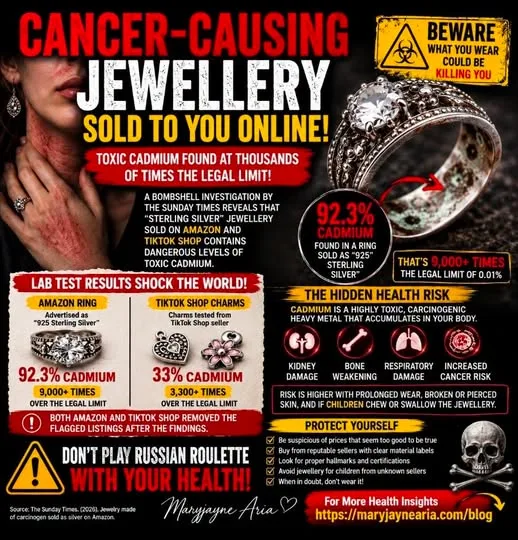
According to an investigation by The Sunday Times, independent laboratory testing uncovered jewellery marketed as sterling silver that contained astonishing amounts of cadmium, a highly toxic heavy metal classified as a human carcinogen.
One of the most alarming discoveries involved a ring advertised as "925 sterling silver." Instead of containing at least 92.5% silver as required by the standard, laboratory analysis found it consisted of 92.3% cadmium. That is more than 9,000 times higher than the legal safety limit of 0.01% permitted in jewellery sold within the UK and European Union.
The investigation also tested charms purchased from a seller on TikTok Shop. These were found to contain approximately 33% cadmium, almost 3,300 times above the legal limit. Following the findings, both Amazon and TikTok Shop reportedly removed the identified product listings.
What Is Cadmium?
Cadmium is not just another heavy metal. It is recognised internationally as a toxic substance that can build up inside the body over many years. Cadmium is cancer causing
Long term exposure has been linked to:
• Kidney damage
• Bone weakening and osteoporosis
• Lung disease
• Increased cancer risk
• Damage to multiple organs
Unlike some toxins that the body can eliminate, cadmium accumulates over time, meaning repeated exposure can gradually increase your body's burden.
Should You Be Worried About Wearing Jewellery?
Experts note that simply touching cadmium-containing jewellery with healthy, intact skin is unlikely to cause immediate poisoning.
However, the risks increase when:
• Jewellery is worn for prolonged periods.
• The jewellery comes into contact with broken or irritated skin.
• Earrings or body jewellery are inserted through pierced skin.
• Young children place jewellery in their mouths or accidentally swallow small pieces.
• Low quality coatings wear away over time, increasing exposure.
Children are considered particularly vulnerable because cadmium can interfere with normal growth and development, and they are more likely to chew or suck on jewellery.
Why This Matters
Many shoppers assume that products sold on large online marketplaces have been independently verified for safety. In reality, third party marketplaces often host millions of products from independent sellers located around the world.
Although many sellers comply with regulations, some products can bypass adequate quality control before they reach consumers.
Material descriptions may not always be independently verified, making it difficult for buyers to know exactly what they are receiving.
How to Protect Yourself
If you regularly purchase jewellery online, consider taking a few simple precautions:
• Be cautious of jewellery advertised at prices that seem far below market value.
• Buy from established retailers with clear quality standards.
• Look for recognised hallmarks on precious metal jewellery.
• Avoid jewellery with vague descriptions such as "silver colour" or "silver plated" when expecting sterling silver.
• Be especially careful when buying jewellery intended for children.
• Stop wearing any jewellery that causes skin irritation or discolouration until its composition can be confirmed.
A Wake Up Call for Consumers
This investigation serves as an important reminder that not every bargain is a bargain. While most jewellery is unlikely to pose a health threat, the discovery of products containing extraordinarily high concentrations of cadmium highlights weaknesses in the oversight of some third party online sellers.
Consumers deserve confidence that products marketed as sterling silver are exactly what they claim to be, not items containing potentially hazardous metals.
Until stronger safeguards are in place, exercising caution when purchasing very inexpensive jewellery online may be one of the simplest ways to reduce unnecessary exposure to toxic substances.
Written by Maryjayne Aria Author of Immune Health, Terrain and GcMaf