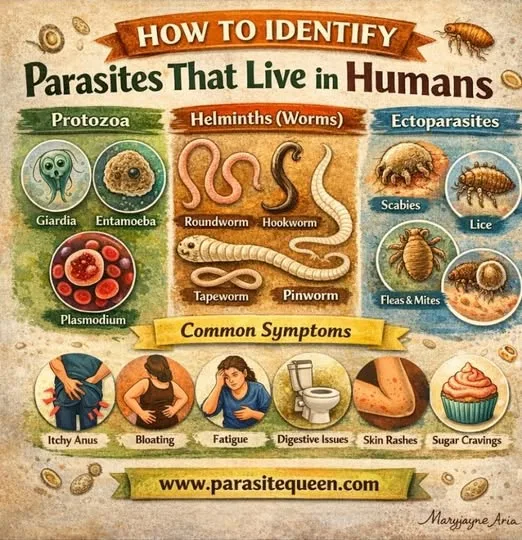
THE QUESTION THAT HAS BOTHERED ME FOR YEARS: How many people across America, Europe, the United Kingdom, Australia and Canada are being diagnosed with something else when the underlying cause may actually be parasitic? After many years studying parasites, I find this question increasingly difficult to ignore. I am not claiming that parasites cause every unexplained illness, and I am certainly not claiming that every death that remains unexplained was caused by a parasite. That would be irresponsible. My question is much more uncomfortable: how many people have been diagnosed, treated and perhaps even died without parasitic disease ever being properly considered?
HOW DO WE COUNT PEOPLE WE NEVER IDENTIFY? This is where the problem becomes almost impossible to measure. Someone who is correctly diagnosed with a parasitic infection enters the statistics as a parasitic case. Someone who has a parasite but is diagnosed with something else enters the statistics under that other diagnosis. Someone who is never tested may never appear in the parasitic disease statistics at all. So when someone tells me that a particular parasitic infection is uncommon, I immediately want to know how thoroughly we are actually looking for it. You cannot accurately measure missed cases by counting only the cases that were successfully identified.
HOW MANY PEOPLE HAVE TO DIE BEFORE PARASITES BECOME A FRONT-LINE QUESTION? This is the question I find most disturbing. How many people have to deteriorate, how many families have to lose loved ones and how many patients have to spend years moving through the healthcare system before parasitic infection becomes a serious front-line consideration when symptoms remain unexplained? I am not asking how many deaths can be blamed on parasites, because that requires evidence on an individual basis. I am asking how many people have to die without a parasite ever being seriously considered before we acknowledge that our diagnostic approach may have a blind spot.
THE MEDICAL EDUCATION PROBLEM: I am currently writing a book about parasites, and one of the reasons I am doing so is because I have become increasingly concerned about how little detailed parasitology education many doctors may receive during medical school. I am not attacking doctors. In fact, I believe many doctors are working within a system that does not give them enough exposure to this subject. A doctor cannot be expected to recognise every unusual parasitic infection if parasitology received only limited attention during their training and they rarely encounter these infections in everyday practice. The responsibility therefore extends beyond individual doctors to medical education itself.
HOW MUCH PARASITOLOGY IS ACTUALLY TAUGHT? There is no universal number of hours that applies to every medical school in America, Europe, Britain, Australia or Canada, and I will not invent one simply to make my argument stronger. Medical curricula vary considerably. However, published research demonstrates that parasitology can receive surprisingly limited teaching time. One published study described bacteriology, mycology and parasitology being combined into a five-hour teaching block. That does not mean every medical school teaches parasitology for only five hours, but it demonstrates the reality that several major areas of infectious disease can sometimes be compressed into an extremely small amount of teaching time. Research examining UK medical schools has also demonstrated substantial variation in what is taught and how teaching time is allocated. My question is therefore simple: if a doctor has received very little practical parasitology education, how can we expect that doctor to recognise complex or unusual parasitic disease years later?
PARASITOLOGY IS NOT SIMPLY LEARNING THE NAMES OF WORMS: The subject is considerably more complicated. Medical parasitology involves life cycles, transmission routes, epidemiology, morphology, tissue involvement, clinical presentations, specimen selection, microscopy, antigen testing, molecular diagnostics, serology and interpretation of laboratory findings. Different parasites require different diagnostic approaches, and some infections can be extremely difficult to identify. If a doctor has limited exposure to these subjects, a parasitic infection may not even enter the differential diagnosis. That is not necessarily a failure by the doctor. It may be a failure to provide sufficient education in the first place.
THE SPECIALIST SHORTAGE: Then I ask another uncomfortable question. Why are there so few highly specialised parasitologists compared with many other areas of medicine? Published research from Australia has documented declining expertise in diagnostic medical parasitology and warned about the consequences of reduced teaching and training. More recent research has raised concerns about shortages of specialist parasitology expertise in North America and Europe. This matters because complex parasitic infections may require knowledge that goes far beyond what a general medical practitioner can reasonably be expected to possess.
THE VICIOUS CIRCLE: I believe there is a potentially dangerous cycle here. If doctors rarely encounter parasites, they may not develop extensive experience recognising them. If there are fewer specialists, fewer complicated cases may be referred for specialist assessment. If fewer cases are investigated, fewer infections are identified. If fewer infections are identified, the disease can appear less important. Then the argument becomes that extensive parasitology training is unnecessary because parasitic disease is uncommon. I find that circular reasoning extremely concerning. Perhaps part of the reason some infections appear uncommon is that we are not looking for them with sufficient expertise.
THE WORLD HAS CHANGED: People travel internationally on a scale previous generations could not have imagined. Food moves across continents. Populations migrate. People live in countries very different from where they were born. Humans interact with animals and environments containing organisms that may not be familiar to local clinicians. Yet I question whether medical education and diagnostic services have adapted quickly enough to this changing reality. A patient does not need to look like the textbook image of a tropical disease patient before parasitology deserves consideration.
THE TRAVEL HISTORY QUESTION: I believe practitioners should be asking much more carefully about travel and exposure history when investigating unexplained illness. Where has the patient lived? Where have they travelled? What food and water have they been exposed to? Have they lived around animals? What occupations have they had? Have they spent time in regions where particular parasites are endemic? These questions do not diagnose a parasite, but they can determine whether the possibility is considered in the first place. I believe this basic history can sometimes be overlooked precisely because parasitology is not high enough on the list of possibilities.
THE NEGATIVE TEST QUESTION: How many people have been tested once, received a negative result and then been told that parasites have effectively been ruled out? I am not saying every negative test is wrong. I am saying that diagnostic testing has limitations and that different parasites require different diagnostic methods. The correct organism, specimen, timing and technique matter. A single negative test should not automatically be treated as proof that every possible parasitic infection has been excluded when the clinical circumstances continue to raise questions.
WHY ARE THERE SO FEW NEW DIAGNOSTICS? This is another issue that bothers me. Medicine has made extraordinary advances in genomics, molecular biology, imaging and laboratory technology. Yet some parasitic infections remain difficult to diagnose, and scientific literature continues to identify the need for improved diagnostics, including molecular methods, antigen detection, point-of-care testing and multiplex approaches. Why, when technology is advancing so rapidly, are we not seeing the same urgency applied to every area of parasitic diagnosis? I want to know why.
THE MONEY QUESTION: Could economics be part of the answer? Developing a new diagnostic test requires substantial investment in research, clinical validation, manufacturing, distribution and laboratory infrastructure. If a particular parasite is considered to affect a relatively small commercial market, the financial incentive to develop an expensive new diagnostic may be limited. I believe this is an uncomfortable conversation that needs to happen. Medical need and commercial profitability are not necessarily the same thing, and I question whether the two are always aligned.
THE INSTITUTIONAL QUESTION: My lack of confidence in the FDA, CDC and WHO makes me question official figures and narratives more closely. I personally believe these organisations have agendas and competing interests that are not always obvious to the public. I am deliberately making that distinction because I believe people should be able to separate documented evidence from personal interpretation. But even if someone has complete confidence in these institutions, the questions surrounding parasitology education, specialist availability, diagnostic limitations and research priorities still remain.
I AM NOT BLAMING DOCTORS: This distinction matters enormously to me. If a doctor received very little parasitology education, then encounters a patient with unusual symptoms years later, I cannot reasonably expect that doctor to possess the knowledge of someone who has spent their career studying parasites. This is exactly why I am writing my book. I want to contribute to education because I believe the gap affects both the public and medical professionals. My work is intended to examine the subject in depth, bring together relevant research and make complex parasitology easier to understand. I believe doctors should have more opportunities to recognise when parasitic disease needs to be considered, and patients should understand enough to ask informed questions.
WHAT I WANT TO SEE: I want parasitology given greater attention during medical education. I want doctors to have practical knowledge of parasite biology, transmission, clinical presentations and diagnostic limitations. I want greater access to genuine parasitology specialists. I want better validated diagnostic methods. I want more research into infections that remain difficult to identify. I want patients with unexplained illness to have their history properly examined rather than having possibilities dismissed simply because they are considered uncommon. Most importantly, I want clinicians to be comfortable asking the question: could this be parasitic?
THE QUESTION OF MISDIAGNOSIS: I cannot honestly tell you that a specific percentage of people in America, Europe, Britain, Australia or Canada are being misdiagnosed because of parasites. There is not enough evidence to give you a scientifically defensible number. I refuse to invent one simply because a dramatic statistic would make a stronger headline. But I also refuse to pretend that the absence of a number proves the absence of a problem. We need research specifically designed to investigate potential underdiagnosis if we genuinely want to understand the scale of it.
THAT IS THE PARADOX: The people who were never correctly diagnosed are precisely the people least likely to appear in statistics about correctly diagnosed disease. A person may spend years carrying another diagnosis. A person may receive treatment for something that does not resolve their symptoms. A person may eventually die without the underlying cause ever being established. None of those situations automatically means a parasite was responsible, but they demonstrate why the question of missed parasitic disease cannot be answered simply by looking at existing confirmed case numbers.
SO I ASK AGAIN: How many people have to die before parasites become a front-line question in the analysis of unexplained illness? How many patients have to spend years searching for answers? How many families have to be left wondering what was missed? How many doctors have to say, "I don't know what is causing this," before we ask whether the differential diagnosis was sufficiently broad? How many potentially useful diagnostic technologies have to remain unavailable before we question whether research priorities are adequately aligned with patient need?
I DO NOT HAVE THE ANSWER: And I will not pretend that I do. The purpose of this article is not to tell you that parasites are responsible for everything. The purpose is to ask why parasitic disease is considered too late, why specialist expertise is limited, why medical education can provide relatively little dedicated exposure and why better diagnostics are not more readily available. These questions deserve evidence based investigation rather than automatic dismissal.
I HAVE SPENT YEARS STUDYING THIS SUBJECT AND I AM STILL ASKING QUESTIONS: The more I study parasites, the more I realise how much there is still to understand. That is why I believe curiosity is essential. If investigation demonstrates that a parasite is not responsible, that is useful information. If investigation demonstrates that a parasite is present, then identifying it may completely change the direction of a patient's care. Either way, the answer should come from proper investigation rather than assumption.
Perhaps the most uncomfortable question is also the simplest: IF WE ARE NOT LOOKING FOR THE PARASITE, HOW CAN WE KNOW WE DID NOT MISS IT? And perhaps the question we should be asking even more urgently is this: HOW MANY PEOPLE HAVE TO DIE BEFORE WE START LOOKING?
Please share this information to help increase awareness wothout making any alterations. Copyright Maryjayne Aria , author of Immune Health, Terrain and GcMAF.
Feel free to visit my health blog: https://maryjaynearia.com/blog