After 15 years of studying parasites, I have become increasingly concerned about a question I believe the medical profession needs to confront: HOW MANY PEOPLE HAVE DIED BECAUSE NOBODY THOUGHT TO TEST THEM FOR PARASITES? I keep coming back to the same disturbing possibility. Patients may have spent months or years searching for answers, receiving treatments that failed to address their underlying illness, while a parasitic infection was never properly investigated. I believe the true extent of missed parasitic diagnoses may be much greater than many people realise, particularly when we consider how little attention parasitology can receive in medical education and how difficult it can be for patients to access specialist expertise. I am particularly concerned about cases in which parasitic infections resemble other serious diseases, including cancer. I want to know how many diagnoses could have been reached earlier, how many patients might have been spared unnecessary suffering, and whether better testing could have changed their outcomes. I cannot give you a reliable figure for preventable deaths, but I believe these questions deserve serious scientific investigation rather than dismissal.
THE GAP IN MEDICAL EDUCATION: One of my biggest concerns is the limited attention parasitology receives during medical training. Doctors study for years, yet receive a very brief introduction to parasites, which cannot possibly cover the enormous diversity of organisms, their life cycles, the diseases they cause, their clinical presentations, and the diagnostic methods needed to identify them. I have seen references to programmes where parasitology receives very limited teaching. Mainly four hours of instruction, where that is the amount provided, cannot begin to prepare a doctor for the full complexity of parasitic disease encountered in clinical practice. Medical curricula vary between countries and universities, but my concern remains that limited teaching leaves huge gaps in practical knowledge. I believe doctors need better education in recognising parasitic infections, understanding the limitations of diagnostic tests, and knowing when specialist advice is necessary. Continuing medical education must also keep pace with research and diagnostic developments. I do not expect every doctor to be an expert in every parasite, but I do believe patients deserve a healthcare system in which parasitic disease is considered when the clinical evidence warrants investigation and when requested by the patient.
WHEN NOBODY THINKS TO TEST, AN INFECTION CAN REMAIN UNDETECTED: This is where I believe a serious diagnostic gap can develop. If a doctor does not consider parasites as a possible cause of a patient's symptoms, the appropriate investigation may never be requested. The patient may receive another diagnosis, undergo repeated investigations, and continue treatment without the underlying cause being identified. Different parasites require different diagnostic methods, and there is no single test that detects every human parasitic infection. Stool microscopy, antigen tests, molecular techniques, blood tests, imaging, and tissue examination all have specific applications and limitations. The appropriate investigation depends on the suspected organism, the patient's symptoms and exposure history, and the site of infection. A negative result does not exclude every parasitic disease. My concern is that clinicians need better training to select appropriate tests and interpret results in context. If a patient's condition remains unexplained, I believe the diagnosis should be reassessed rather than allowing an initial assumption to go unchallenged.
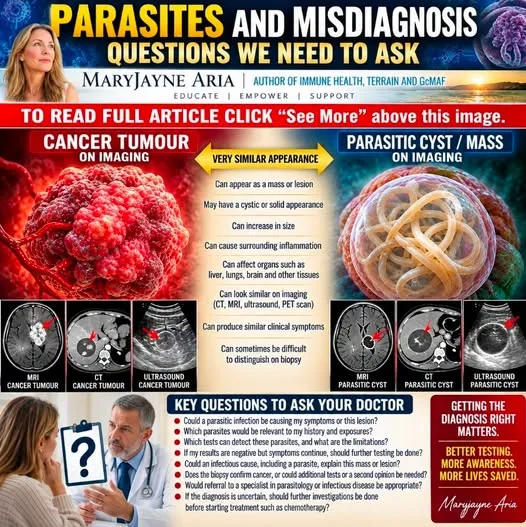
THE ONCOLOGY CONNECTION THAT CONCERNS ME MOST:There is geat potential for certain parasitic infections to mimic cancer, this deserves far greater attention. Some parasites can produce cysts, nodules, masses, and lesions that strongly resemble tumours on medical imaging. Echinococcosis, for example, can cause cystic lesions in organs such as the liver and lungs, while cerebral toxoplasmosis can produce brain lesions that strongly resemble tumours in many clinical circumstances, particularly in immunocompromised patients. These are recognised diagnostic challenges. My concern is that when a parasitic infection is not considered, an infectious cause does not receive the investigation it deserves. I believe we need to examine documented cases in which a lesion initially suspected to be malignant is later found to have an infectious cause. How often could earlier consideration of an infection have helped clarify the diagnosis? Were there clues in the patient's history, imaging, or tissue findings that warranted further investigation? Could access to specialist expertise have made a difference? I believe the scale of missed parasitic disease is far greater than people understand.
COULD A PATIENT RECEIVE CHEMOTHERAPY FOR A DISEASE THEY DO NOT HAVE? This is one of the most serious consequences of a cancer misdiagnosis. Chemotherapy causes substantial toxicity, including suppression of the immune system, serious infections, and damage to healthy tissues. If a lesion is caused by a parasitic infection rather than malignancy, cancer treatment is inappropriate and exposes the patient to avoidable harm. I believe this deserves serious consideration whenever the clinical findings justify investigating an infectious cause. I do believe that a suspicious mass should be investigated as parasitic disease. My point is that accurate diagnosis must come first. Imaging alone can not establish the cause of a lesion, and further investigation should be necessary to establish uncertainty. I strongly believe clinicians should consider appropriate additional testing before making major treatment decisions.
CAN A BIOPSY BE MISINTERPRETED? A biopsy is another diagnostic tool, but some parasitic infections produce the same inflammatory reactions, tissue damage, cysts, and other changes that as Cancer does, this complicates the interpretation of a lesion. Examination of tissue may identify a parasite or structures associated with infection, while additional stains, molecular testing, or specialist pathological review may help clarify an uncertain diagnosis. I believe doctors and pathologists need to remain aware of infections that can resemble malignancy and recognise that further investigation is warranted. Parasites and cancer are not routinely indistinguishable under the microscope, and the presence of a parasite does not automatically exclude cancer. However, when tissue findings do not adequately explain the clinical picture, I believe a second opinion or further testing should be considered. My concern is that biopsies can be unreliable, no diagnostic method should be interpreted without considering the relevant clinical evidence.
WE NEED BETTER TESTING AND NEW DIAGNOSTIC APPROACHES: I believe improving parasite detection must become a greater priority. We need more research into the limitations of existing tests, better access to specialised investigations, and validated diagnostic methods that can detect infections current approaches may miss. I would particularly like to see further research into parasitic infections affecting different organs and tissues, as well as diagnostic approaches that help distinguish infectious lesions from malignancy when their appearances overlap. Billions of dollars have been invested into Cancer research yet little has been invested into parasites.
More attention is required in collaboration between parasitology experts, infectious disease specialists, oncologists, pathologists, and laboratory researchers. We also need systematic studies of cases in which the original diagnosis was later revised, so that researchers can identify where diagnostic processes failed and what might improve them. I do not believe we should simply accept the limitations of current testing without asking how they can be overcome. Better technology must be properly validated, clinically evaluated, and made accessible to patients. Without reliable data, we cannot establish the full extent of missed infections or determine which improvements would make the greatest difference.
QUESTIONS PATIENTS SHOULD FEEL ABLE TO ASK THEIR DOCTORS: If you suspect a parasitic infection could be contributing to your symptoms, I believe you should feel comfortable raising the concern and asking for a clear explanation. You do not need to arrive with a diagnosis. Instead, ask whether your symptoms, travel history, food or water exposures, animal contact, or other relevant circumstances make testing appropriate. Ask which parasites would be relevant, which tests could detect them, and what the limitations of those tests are. If the results are negative but your symptoms continue, ask what other explanations should be considered and whether further investigation or referral to an infectious disease specialist would be appropriate. If a scan identifies a suspicious mass, you can ask what evidence supports the suspected diagnosis, whether an infectious cause is a reasonable possibility, and whether the imaging findings establish the cause or require additional investigation. If a biopsy has been performed, ask what the pathology report actually confirms and whether further testing or specialist review is warranted if the findings remain uncertain. These questions are not an assumption that parasites must be responsible. They are a way to encourage a careful, evidence-based discussion about the possible causes of your illness. Patients should ask their treating team to explain any genuine uncertainty about the diagnosis no matter how small that uncertainty is.
MY CONCERN AFTER 15 YEARS OF STUDYING PARASITES: I am not claiming that parasites explain every chronic illness, every cancer, or every unexplained symptom. That would not be scientifically responsible. I am saying that parasitic infections can cause serious disease, that some can be difficult to diagnose, and that certain infections can resemble other conditions, including malignancy. I believe the gap between what doctors are taught, what they encounter in practice, and what they know to investigate deserves much closer examination. I also believe the true extent of missed parasitic diagnoses is greater than many people appreciate, although we need reliable research to establish the scale of the problem. I want to see better medical education, greater access to specialist expertise, improved testing, and more research into cases where parasitic infections have been missed or initially mistaken for other diseases. Above all, I want patients to have their concerns taken seriously and reasonable diagnostic possibilities investigated rather than dismissed simply because they are unfamiliar.
HOW MANY MORE PATIENTS MUST SUFFER BEFORE THIS GAP IS TAKEN SERIOUSLY? I believe medical schools, healthcare providers, laboratories, oncologists, pathologists, infectious disease specialists, and researchers need to examine this issue together. We must ask whether parasitology receives sufficient attention in medical education, whether appropriate diagnostic services are accessible, and whether current testing methods are adequate. We must also investigate whether parasitic infections that mimic malignancy are being recognised as early as possible and whether improved diagnostic approaches could prevent some patients from receiving inappropriate treatment. I believe lives may have been lost because parasitic infections were never properly investigated, but the scale of that problem must be established through evidence rather than invented figures. If diagnoses are being missed, we need to understand why. If testing methods have limitations, we need to improve them. If doctors need more education, we need to provide it. For me, this is about patient safety, diagnostic responsibility, and the willingness to look beyond the obvious when the evidence justifies doing so. My question is simple: IF BETTER EDUCATION, BETTER TESTING, AND EARLIER RECOGNITION COULD PREVENT SOME PATIENTS FROM SUFFERING OR DYING, WHY ARE WE NOT DOING MORE TO MAKE THAT HAPPEN?
Please share this information to help increase awareness without making alterations. Copyright Maryjayne Aria , author of Immune Health, Terrain and GcMAF.
For more information and discussion about parasites, join my Parasite Queen group: