HOW MANY MEDICAL MALPRACTICE CASES ARE RECORDED YEARLY?
I have been examining the numbers surrounding medical malpractice, medical negligence, patient harm and vaccine injury, and one disturbing reality becomes impossible to ignore: the cases officially recorded are not the same as the number of people who may actually have been harmed. There is no single international database capturing every medical mistake, negligent treatment, delayed diagnosis, medication error, surgical error, device failure, injury or death. Instead, the evidence is scattered across legal systems, compensation schemes, professional reporting systems and adverse-event databases to confuse the numbers. That gap is not a minor technicality. It is to conceal the true human cost of medical failure.
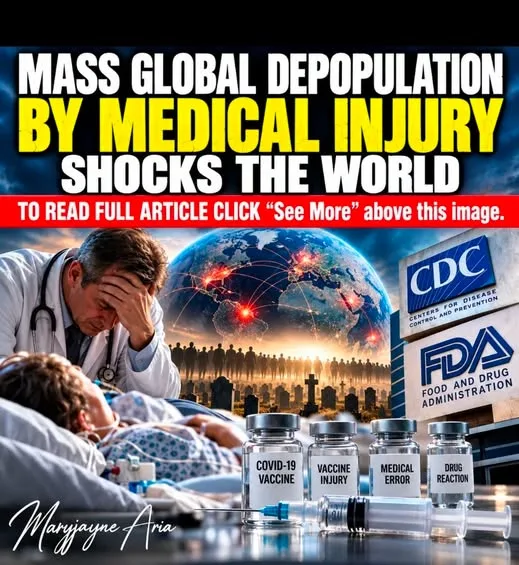
In my opinion, this is far more than ordinary underreporting or administrative weakness. It represents a devastating form of depopulation through preventable medical harm: people injured, disabled or killed when healthcare systems fail to identify, investigate and correct dangerous practices. The consequences extend beyond recorded deaths. They include infertility caused by medical injury, treatment-related reproductive harm and unborn children who are never conceived or carried to birth as a result. I am presenting “depopulation” as an established statistical conclusion, I believe the scale of unrecorded harm is so serious that it must be confronted directly rather than buried beneath incomplete databases and reassuring official language.
UNITED STATES: The American National Practitioner Data Bank records medical malpractice payment reports. These are not every lawsuit filed. They are malpractice payments made on behalf of healthcare practitioners following a written claim or judgment. The NPDB itself states that it DOES NOT contain every lawsuit filed against healthcare practitioners. The recorded malpractice payment reports for the six complete calendar years from 2020 through 2025 were approximately 9,685 in 2020, 9,307 in 2021, 11,203 in 2022, 11,676 in 2023, 11,627 in 2024 and 11,263 in 2025. That is approximately 64,761 reported malpractice payment records across those six years. But these figures still do not represent the majority of malpractice claims because claims that close without a reportable payment are not included. The NPDB currently contains more than 529,000 cumulative medical malpractice payment reports dating back to 1990.
HOW MUCH IS PAID OUT? The amount paid in malpractice claims is substantial, but it is not a complete measure of the harm suffered. In the United States, the NPDB has recorded hundreds of billions of dollars in cumulative medical malpractice payments since reporting began, with annual payments commonly reaching several billion dollars. In England, NHS Resolution reported approximately £2.8 billion in clinical-negligence payments during 2024/25, including damages and associated legal costs. These figures reveal the staggering financial consequences of malpractice claims, they also expose how expensive and entrenched the system has become. The money paid does not simply represent compensation for injury.
AMERICA AND THE DEATH QUESTION: This is where I become extremely concerned. The United States has previously produced estimates ranging from tens of thousands of deaths associated with medical error to much higher figures. The estimate by Makary and Daniel suggested approximately 251,454 deaths annually! My own view is that we should not pretend we know the true number when the systems used to record malpractice cases clearly do not capture the majority of incidents. I fear the real death figure from medical mistakes, failures, omissions, delayed diagnoses, medication errors, infections and other preventable healthcare harm could be substantially higher than the figures commonly quoted. I also believe the wider demographic consequences include infertility, reproductive injury and pregnancies or births that never occur, none of which are captured in ordinary malpractice-death statistics. I personally suspect the true figure could be more than triple some of the estimates that have circulated. In my opinion, when preventable harm is widespread, concealed by fragmented reporting and allowed to continue without full accountability, it becomes serious depopulation in effect: people are lost, families are devastated, fertility affected, unborn children may never come into existence and the true scale remains obscured.
WHY THERE IS NO SIMPLE LIST: People often ask why there is no complete public list of every medical malpractice case, every negligent practitioner, every settlement and every patient harmed. The answer is that the information is divided among courts, insurers, hospitals, regulators, compensation programmes and private solicitors which protects true figures. Many cases are never filed in court. Some are withdrawn, dismissed, resolved through mediation or settled before trial. Some payments are made without a public judgment, while other cases involve confidentiality provisions. Privacy laws also restrict the publication of patient identities and detailed medical information. Professional databases may record payments or disciplinary findings, but they do not record most of the allegations, most settlements or the majority of underlying incidents. As a result, there is no single reliable list that the public can search to see the full scale of medical negligence. This concerns me!
THE COST AND TIME OF PURSUING A CLAIM: The current system also makes malpractice claims difficult and extremly expensive to pursue. A patient usually needs medical records, expert opinions, legal advice and evidence linking the treatment to the injury. Some lawyers may work on a conditional-fee or contingency basis, but cases still involve substantial costs for medical experts, court fees, barristers, investigators and independent assessments. Defendants often have access to large insurers, hospital legal departments and specialist defence lawyers, while an injured patient is often seriously ill, dead, grieving, unable to work or struggling financially.
A medical-malpractice case can take years to resolve. In England, NHS Resolution has noted an average delay of at least three years between the incident and the claim, and the legal process can continue for several more years after that and the cases are often appealed. Complex cases involving birth injury, delayed diagnosis, catastrophic disability or death may take five years, ten years or longer. In the United States and other countries, limitation periods can expire before a patient understands what happened. The longer a case continues, the more difficult it is to obtain records, locate witnesses and reconstruct the clinical decisions involved. Many people therefore abandon claims or accept settlements because they cannot afford the emotional, financial and physical burden of continuing.
ENGLAND: The NHS provides a much clearer window into the scale of clinical negligence. NHS Resolution recorded 12,629 new clinical negligence claims and reported incidents in 2020/21. In 2021/22 the figure rose to 15,078. In 2022/23 it was 13,511. For 2023/24, NHS Resolution recorded 10,834 claims under the Clinical Negligence Scheme for Trusts and another 2,382 involving general practice, giving 13,216 across those two major clinical schemes. In 2024/25, NHS Resolution received 14,428 new clinical negligence claims and reported incidents. These are extraordinary numbers, particularly when we remember that a claim is only the visible part of the problem. NHS Resolution itself says there is a significant time lag between the incident and the claim, with an average of around three years.
ENGLAND AND WHAT THE NUMBERS REVEAL: In 2024/25, NHS Resolution resolved 13,329 clinical claims. Of these, 7,?52 resulted in damages payments, while thousands were resolved without damages. A remarkable 11,110 clinical claims were resolved without formal legal proceedings. The fact that many cases never reach a courtroom does not mean nothing happened. A claim can be investigated, negotiated, mediated, withdrawn or resolved without a judge ever determining the facts. This is precisely why I believe simply counting court cases gives the public a dangerously incomplete picture.
SETTLEMENTS AND NON-DISCLOSURE AGREEMENTS: Many clear cases are settled out of court rather than decided at trial. A settlement may provide compensation to a patient or family, but it does not necessarily create a public judgment confirming what happened. Some settlements include confidentiality clauses or non-disclosure agreements that prevent the patient, family or professionals involved from discussing the facts publicly. In other cases, the settlement may be described as an admission of liability, while in others the defendant pays without formally admitting fault. These agreements can protect privacy and bring an end to a painful legal dispute, but they also mean that important cases disappear from public view. The public often never learns how many people were affected, what went wrong or how much was paid. This is another reason there is no complete list of malpractice cases and why official court statistics almost certainly understate the number of disputes.
CANADA: Canada has another important source of information through the Canadian Medical Protective Association. Its 2024 annual report gives a five-year view of new medico-legal matters. New medico-legal cases numbered 7,948 in 2020, 8,206 in 2021, 8,194 in 2022, 8,538 in 2023 and 9,109 in 2024. That is 41,995 new medico-legal cases over those five years. The Canadian figures are not directly interchangeable with American malpractice-payment figures because the CMPA category includes different types of medico-legal matters. This is exactly the problem when people try to produce one neat international malpractice number. The systems are not measuring exactly the same thing.
AUSTRALIA: Australia also demonstrates why reporting systems matter. Data released through Australia's National Claims and Policies Database recorded 6,861 medical indemnity/malpractice claims in 2020, 7,256 in 2021, 5,051 in 2022 and 4,818 in 2023. That is 23,986 reported claims over those four calendar years. Australia's Australian Government Actuary also states that roughly 2,000 negligence claims might be expected each year in relation to private medical practice alone, while acknowledging substantial variation and the difficulty of projecting claim numbers precisely. The Australian Prudential Regulation Authority's NCPD contains claims data from APRA-regulated insurers and is updated periodically, but the published data are privacy masked.
EUROPE: This is where the statistics become even more disturbing because there is no single Europe-wide database that records every medical malpractice lawsuit. European countries operate different legal systems, compensation schemes and reporting mechanisms. The European Commission has nevertheless estimated that between 8% and 12% of patients admitted to hospitals in the EU experience adverse events while receiving healthcare. These include healthcare-associated infections, medication errors, surgical errors, medical-device failures, diagnostic errors and failures to act on test results. The European Parliament has also noted that the available data on adverse events across EU healthcare systems are limited and that nearly half of these events could be avoidable. This tells me something very important: the number of people experiencing healthcare-related harm is potentially vastly larger than the number who ever file a malpractice claim.
EUROPE AND DEATHS: European data have historically estimated approximately 4.1 million healthcare-associated infections each year in the EU and approximately 37,000 deaths annually associated with those infections. That is only one category of healthcare harm. It does not represent all medical errors, diagnostic failures, medication mistakes, surgical errors or other forms of preventable harm. It also does not capture infertility, reproductive injury, pregnancy loss or unborn children who are never conceived or born as a consequence of medical harm. When I look at these figures together, I find it impossible to believe that malpractice databases alone tell us the true human cost of modern healthcare. In my opinion, allowing such preventable deaths and reproductive consequences to remain fragmented across disconnected systems is not a minor statistical problem. It is a serious depopulation concern that demands urgent, independent investigation.
VACCINE DAMAGE: Vaccine injury must also be examined separately because vaccine adverse-event reporting is not the same as malpractice reporting. In the United States, VAERS is jointly operated by the CDC and FDA and accepts reports of health problems occurring after vaccination, including serious events such as hospitalization, disability and death. The important point is that VAERS records events reported after vaccination and does not automatically establish causation. The reporting system recorded approximately 49,137 US reports in 2020 and approximately 752,660 in 2021, showing the enormous change in reporting volume during the COVID-19 vaccination programme. The CDC and FDA expanded public access to VAERS data in May 2025, including additional secondary reports that had previously not appeared in the public datasets.
AMERICAN VACCINE COMPENSATION: The United States also has compensation systems separate from VAERS. The Countermeasures Injury Compensation Program had received 14,830 claims across fiscal years 2010 through 2026 as of September 1, 2026. Of 8,730 decisions, 160 claims had been found eligible for compensation and 93 had actually been compensated at that point. The National Vaccine Injury Compensation Program has also continued to compensate claims involving vaccines covered by the programme. Importantly, compensation through the VICP does not always mean HHS has formally concluded that the vaccine caused the injury because most cases are resolved through negotiated settlements.
CANADIAN VACCINE INJURY: Canada provides an even clearer example of the gap between an adverse-event report and a compensation claim. The former Vaccine Injury Support Program received 3,557 claims between June 2021 and November 2025. Of those, 3,018 were found admissible, 1,433 had been assessed by a Medical Review Board, and 252 had been approved by the Board. More than C$21.47 million had been paid in financial support. Canada separately recorded 2,835 adverse-event reports following immunization in 2024, including 226 classified as serious. Again, these are different systems measuring different things.
ENGLAND AND VACCINE DAMAGE: Britain's Vaccine Damage Payment Scheme recorded 1 awarded claim in 2021/22, 72 in 2022/23, 99 in 2023/24, 55 in 2024/25 and 34 in 2025/26, giving 261 awarded claims across those financial years. But the number of applications was dramatically larger. Between November 2021 and July 2025, more than 22,000 VDPS claims had been received, with the overwhelming majority relating to COVID-19 vaccination. That difference between applications and successful awards is something the public needs to understand.
AUSTRALIA AND VACCINE DAMAGE: Australia has its own adverse-event reporting system through the Therapeutic Goods Administration. The TGA's Database of Adverse Event Notifications contains reports of suspected adverse events involving medicines, vaccines and biological therapies. The TGA explicitly describes these as suspected associations, not automatically confirmed causation. An Australian government FOI response covering COVID-19 vaccine reports received between 2020 and 2023 recorded 139,820 COVID-19 vaccine adverse-event reports in the DAEN medicines database, including 1,014 reports with an outcome of death. These are reports following vaccination.
MY VIEW OF THE CDC AND FDA: I have become deeply distrustful of the way the CDC, MRHA and FDA have handled questions surrounding medical harm and vaccine safety. I believe regulators should be relentlessly independent, completely transparent and prepared to investigate uncomfortable evidence regardless of where it leads. I do not believe public confidence should ever be protected by minimising inconvenient information. I believe the public has the right to see the raw data, the methodology, the safety signals, the serious adverse-event reports, the compensation claims and the outcomes of investigations. When regulators tell people not to question the system, I question it even more. The job of a regulator is not to protect a product, a manufacturer, a government narrative or institutional reputation. Its first responsibility should be the patient.
WHAT THESE NUMBERS TELL ME: When I put America, England, Canada, Australia and Europe side by side, I do not see evidence that medical harm is a tiny or insignificant problem. I see millions of people receiving healthcare every year and a fraction of the resulting harm entering legal, compensation or adverse-event databases. I see claims that can take years to appear. I see cases settled without court proceedings, including settlements covered by confidentiality or non-disclosure agreements. I see injuries that never become claims. I see adverse events that are never reported. I see compensation systems with strict eligibility requirements. I see deaths recorded under ordinary medical causes rather than being connected to an earlier medical error. I also see infertility, reproductive harm, pregnancy loss and other consequences that may never be linked to medical treatment in population statistics. And I see enormous differences between what happened to a patient and what ultimately appears in a database.
In my opinion, this is mass depopulation through a system that fails to count, investigate and prevent preventable harm. I am not claiming that every medical injury or death is intentional, nor that every adverse event proves causation. I am saying that when large numbers of people are harmed, when many cases remain invisible and when institutions resist full transparency, the result is a serious loss of human life and reproductive potential that must not be minimised. The consequences is measured not only in recorded deaths, but also in children who are never conceived, never carried to term or never born.
THE FIGURE I FEAR: This is why I am unwilling to accept the recorded malpractice figures as the true measurement of medical harm. The databases tell us what was reported. They do not tell us everything that happened. I fear the real number of people seriously injured or killed through preventable medical errors is much higher than the official malpractice figures suggest. I also fear that the wider demographic impact, including infertility and unborn children lost through medical consequences, could reach into the billions globally over time. I suspect the true death toll could be more than triple some commonly quoted estimates. I can absolutely say that I believe the question deserves far more serious investigation than it receives. If the true scale of preventable harm is being hidden by underreporting, delayed claims, confidential settlements and inadequate investigations, then we are facing a serious depopulation crisis in practical terms, potentially comparable in human consequence to a WORLD WAR, regardless of what institutions choose to call it.
WE NEED BETTER RECORDING: Every serious medical error should be recorded. Every unexpected death following treatment should be investigated properly. Every medication error, diagnostic failure, surgical mistake, device problem and preventable infection should be visible in a transparent national database. Vaccine injuries should be recorded separately but connected to long-term health outcomes so patterns can actually be investigated. Reproductive outcomes should also be monitored, including infertility, pregnancy loss, fetal injury and changes in birth rates where there is credible evidence of possible medical or treatment-related effects. Regulators should also publish aggregate information about claims, settlements, damages paid, legal costs and cases resolved through confidentiality agreements, while protecting patient privacy. The public should be able to understand how many cases are brought, how long they take, how much is paid and how many are settled without a public finding.
I am certainly not interested in protecting an institution's reputation. I am interested in protecting people. If medicine is going to demand enormous trust from the public, then medicine must also accept enormous accountability when things go wrong. If institutions refuse to measure the harm properly, they cannot credibly claim that the harm is rare. And if preventable deaths, infertility and reproductive losses continue while the evidence remains fragmented and hidden, I believe the public has every right to regard this as serious depopulation and demand immediate accountability.
Please share this information to help increase awareness without making any changes. Copyright Maryjayne Aria , author of Immune Health, Terrain and GcMAF.