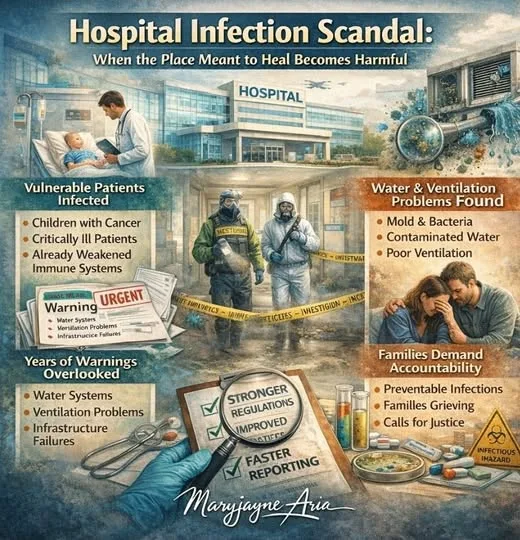
Hospitals are meant to be places of safety, healing, and recovery. But a growing scandal surrounding serious infections at a major hospital has shaken public confidence in the healthcare system and raised disturbing questions about hospital safety.
Families whose loved ones were admitted for treatment now say the very building that was meant to save lives may have contributed to their suffering and, in some cases, their deaths.
A Hospital Under Scrutiny
The controversy centres around Queen Elizabeth University Hospital in Glasgow, one of the largest hospitals in Europe. Over several years, patients, including children being treated for cancer, developed severe infections while receiving care inside the hospital.
These infections were not random.
Investigations began to reveal a troubling pattern linked to the hospital environment itself.
Reports suggested that water systems, ventilation units, and building infrastructure may have allowed dangerous bacteria and mould to circulate within certain wards.
For patients whose immune systems were already weakened, the consequences were devastating.
Vulnerable Patients at Risk
Many of the patients affected were already battling serious illnesses.
Some were children undergoing chemotherapy whose immune systems had been suppressed by life saving treatments. Others were critically ill patients requiring intensive care.
In such cases, even a small amount of environmental contamination can pose a serious risk.
Hospitals normally maintain strict infection control procedures designed to protect vulnerable patients. When those protections fail, infections can spread quickly among those least able to fight them.
Families say that is exactly what happened.
The Infections
Investigations linked several cases to bacteria commonly found in contaminated water systems.
These included organisms that can cause severe bloodstream infections, pneumonia, and organ failure in vulnerable patients.
There were also reports of mould contamination in certain areas of the hospital, which can pose serious risks to patients with weakened immune systems.
Some of the infections proved fatal.
For the families involved, the tragedy was compounded by the belief that these infections could have been prevented.
Years of Warnings
One of the most troubling aspects of the scandal is the claim that concerns had been raised long before the situation reached public attention.
Staff members and infection control specialists reportedly warned about potential problems related to the hospital’s infrastructure.
These concerns included:
• Problems with ventilation systems
• Water contamination risks
• Construction related design issues
• Maintenance failures within the building
Critics now argue that early warnings may not have been addressed quickly enough.
Families Demand Accountability
Families affected by the infections have spent years calling for answers.
Many say they were not fully informed about the potential risks inside the hospital while their loved ones were receiving treatment.
Some parents whose children became infected have accused authorities of failing to be transparent about what was happening.
For them, the issue is not just about a building defect.
It is about trust.
When people enter a hospital, they assume that every possible step has been taken to protect them from harm.
When infections appear to originate within the hospital environment itself, that trust is deeply shaken.
Criminal Investigations
The seriousness of the situation has now led to formal investigations.
Authorities are examining whether failures in hospital management or building design may have contributed to patient harm.
In an extraordinary development, investigators are considering whether the circumstances could amount to corporate homicide, a legal category used when negligence in an organization leads to death.
Such investigations are rare in healthcare settings and reflect the gravity of the allegations.
Hospital Infrastructure and Modern Medicine
The scandal has also sparked a broader conversation about hospital design and infrastructure.
Modern hospitals are extremely complex environments that rely on sophisticated ventilation systems, sterile water supplies, and carefully controlled air quality.
If any of these systems fail, bacteria and mould can spread through the building.
Maintaining these systems requires constant monitoring, rapid maintenance responses, and transparent reporting when problems arise.
Experts say hospital buildings must be treated almost like living systems that require continuous oversight.
Restoring Trust
Healthcare authorities now face the difficult task of restoring public confidence.
For the families affected, answers alone may not be enough. Many want systemic changes to ensure that similar failures cannot occur again.
Calls have been made for:
• Independent oversight of hospital infrastructure
• Stronger infection monitoring systems
• Faster reporting of environmental risks
• Greater transparency with patients and families
Hospitals exist to protect life.
When patients become victims of preventable infections within their walls, it raises one of the most serious questions healthcare systems can face.
How safe are the places meant to heal us?
Written by Maryjayne Aria, author of the book Immune Health, Terrain & GcMAF.



