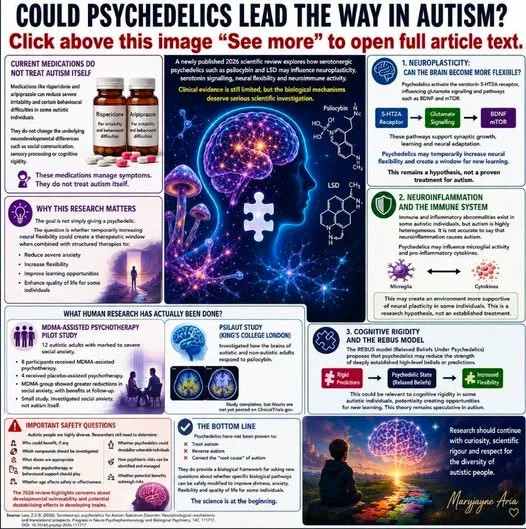
A newly published scientific review is raising an important and controversial question: could psychedelic compounds eventually help address some of the underlying biological mechanisms associated with Autism Spectrum Disorder, rather than simply treating individual symptoms?
The 2026 review, published in Progress in Neuro-Psychopharmacology and Biological Psychiatry, examines the potential of serotonergic psychedelics, including psilocybin and LSD, to influence neuroplasticity, serotonin signalling, neural flexibility and neuroimmune activity. The authors are careful to emphasise that clinical evidence remains limited, but argue that the biological mechanisms deserve serious scientific investigation.
CURRENT PTESCRIBED MEDICATIONS DO NOT TREAT AUTISM ITSELF
At present, medications used in autism are generally prescribed to help manage associated symptoms or co-occurring difficulties.
For example, risperidone and aripiprazole can be used to reduce severe irritability and certain behavioural difficulties in some autistic individuals. However, these medications do not directly change the fundamental neurodevelopmental characteristics associated with autism, such as differences in social communication, sensory processing or cognitive rigidity. This has led researchers to ask whether future treatments might target underlying biological processes instead of focusing exclusively on symptom management.
That is where psychedelic research enters the discussion.
1. NEUROPLASTICITY: CAN THE BRAIN BECOME MORE FLEXIBLE?
One of the central theories discussed in the new review involves neuroplasticity.
Neuroplasticity is the brain's ability to form, modify and reorganise neural connections. Childhood and adolescence are periods of particularly intense plasticity, during which the brain is rapidly learning from the environment. The review discusses the possibility that some aspects of autism may involve differences in developmental timing and plasticity, potentially contributing to rigid or strongly established patterns of neural processing.
Psychedelic compounds such as psilocybin and LSD strongly influence the serotonin 5-HT2A receptor. Experimental research suggests that activation of this receptor can influence glutamate signalling and downstream pathways involving molecules such as brain-derived neurotrophic factor, known as BDNF, and mTOR. These pathways are involved in synaptic growth, learning and neural adaptation. The intriguing hypothesis is that psychedelics may temporarily increase neural flexibility and potentially create a window in which established patterns become more modifiable.
However, this is an important point: the idea that psychedelics can "reopen critical developmental periods" in autistic humans remains a scientific hypothesis. It has not yet been proven as a clinical treatment for autism.
2. NEUROINFLAMMATION AND THE IMMUNE SYSTEM
The review also examines neuroimmune signalling. Research has identified immune and inflammatory abnormalities in some autistic individuals, but autism is highly heterogeneous. It would therefore be inaccurate to claim that chronic neuroinflammation is the single cause of autism or that all autistic people have the same inflammatory biology. Nevertheless, the interaction between the immune system, brain development and neural plasticity is an important area of research.
Experimental studies suggest that serotonergic psychedelics may influence inflammatory signalling, including microglial activity and certain pro-inflammatory cytokine pathways. The review proposes that, under some circumstances, this could potentially create a biological environment more supportive of neural plasticity. Again, this is a promising research hypothesis rather than an established treatment. No psychedelic has yet been proven to treat autism by reducing neuroinflammation.
3. COGNITIVE RIGIDITY AND THE REBUS MODEL
Another fascinating idea involves how the brain makes predictions.
The human brain constantly builds models of the world and uses previous experience to predict what will happen next.
The REBUS model, short for Relaxed Beliefs Under Psychedelics, proposes that psychedelic states may temporarily reduce the strength of deeply established high-level expectations or beliefs.
In simple terms, the brain may become temporarily less constrained by its usual predictions.
The authors of the new review suggest this could potentially be relevant to cognitive rigidity, which can be a significant difficulty for some autistic individuals. If certain patterns of thought or behaviour become extremely established, temporarily increasing psychological and neural flexibility might theoretically create an opportunity for new learning. However, this theory remains speculative in autism. It is a model for future research, not evidence that psychedelics can correct autistic cognition or "normalise" autistic brains.
WHAT HUMAN RESEARCH HAS ACTUALLY BEEN DONE?
This is where the conversation needs to remain grounded. Human clinical evidence is still extremely limited. One small randomised, double-blind pilot study investigated MDMA-assisted psychotherapy in 12 autistic adults with marked to severe social anxiety.
Eight participants received MDMA-assisted psychotherapy and four received placebo-assisted psychotherapy. The MDMA group showed greater reductions in social anxiety, with benefits still observed at follow-up. These findings were very encouraging, but the study was very small. Importantly, it investigated social anxiety in autistic adults. It did not demonstrate that MDMA treated autism itself.
Research involving psilocybin is also developing. The PSILAUT study, sponsored by King's College London, investigated how the brains of autistic and non-autistic adults respond to psilocybin. The registered study is now listed as completed, although the ClinicalTrials.gov record currently shows no posted results.
WHY THIS RESEARCH IS IMPORTANT
The most interesting aspect of this emerging field is not the idea of simply giving a psychedelic drug to someone with autism. The more sophisticated scientific question is whether temporarily increasing neural flexibility could create a therapeutic window. For example, future research may investigate whether carefully controlled pharmacological interventions, combined with structured behavioural or psychological therapies, could help some individuals develop greater flexibility, reduce severe anxiety or modify particularly distressing patterns. The review specifically argues that future research should consider structured therapeutic integration, individual biological differences and the considerable heterogeneity of autism.
IMPORTANT SAFETY QUESTIONS
There are also major unanswered questions. Autistic people are highly diverse, meaning that a treatment potentially beneficial for one person could be ineffective or harmful for another.
Researchers still need to determine:
• Which individuals, if any, could benefit. • Which compounds should be investigated. • What doses are appropriate. • What role psychotherapy or behavioural support should play. • Whether age affects safety or effectiveness. • Whether psychedelics could destabilise vulnerable individuals. • How psychiatric risks can be identified and managed. • Whether potential benefits outweigh risks.
The 2026 review specifically highlights concerns about developmental vulnerability and the possibility of destabilising effects in developing brains. This makes rigorous safety research particularly important before considering any clinical application in younger populations.
THE BOTTOM LINE: The idea that psychedelics could one day help influence some of the biological processes associated with autism is scientifically plausible and worthy of further research. There are interesting mechanisms involving serotonin, 5-HT2A receptors, neuroplasticity, BDNF, mTOR signalling, neural flexibility and neuroimmune activity. But we must be precise about where the science currently stands.
Psychedelics have not yet been proven to treat autism. They have not yet been proven to reverse autism. They have not yet been proven to correct the "root cause" of autism.
What the new research review provides is something different and potentially very valuable: a biological framework for asking new questions. The future of autism research may increasingly move beyond simply suppressing individual symptoms and toward understanding whether specific biological pathways can be safely modified to improve distress, anxiety, flexibility and quality of life for some individuals. That possibility is exciting. But for now, the science is still at the beginning. Research should continue with curiosity, scientific rigour and respect for the diversity of autistic people, without turning promising biological theories into medical claims before the evidence is available.
Source: Low, Z.X.B. (2026). Serotonergic psychedelics for Autism Spectrum Disorder: Neurobiological mechanisms and translational prospects. Progress in Neuro-Psychopharmacology and Biological Psychiatry, 147, 111717. DOI: 10.1016/j.pnpbp.2026.111717.



