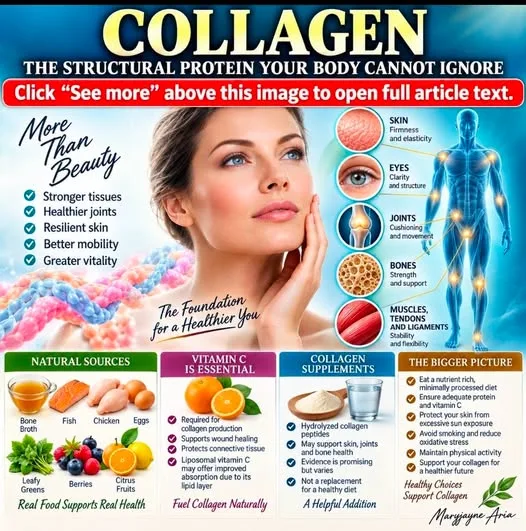
Collagen is far more than a beauty supplement. It is one of the most abundant proteins in the human body, accounting for approximately 25% to 30% of total body protein and forming a major structural component of skin, bone, cartilage, tendons, ligaments, blood vessels, teeth and the cornea. Rather than being simply something that keeps skin looking youthful, collagen provides the framework that gives many tissues their strength, structure and mechanical integrity.
WHAT HAPPENS TO COLLAGEN AS WE AGE: Collagen metabolism changes throughout life. As we get older, collagen synthesis decreases while degradation and structural changes can increase. This contributes to changes in skin elasticity, hydration and thickness, but the consequences extend beyond appearance. Collagen is part of the extracellular matrix surrounding cells, meaning changes in collagen can influence the physical environment in which connective tissues function. Aging therefore affects collagen throughout the body, not simply in the face.
SKIN AND COLLAGEN: Skin is one of the tissues where collagen decline becomes particularly visible. Collagen provides much of the dermal framework that supports firmness and elasticity. Ultraviolet radiation, smoking, oxidative stress and nutritional deficiencies can all contribute to processes that damage or interfere with collagen. This is one reason protecting the skin from excessive ultraviolet exposure and maintaining adequate nutrition matters alongside any consideration of supplementation.
VITAMIN C IS ESSENTIAL FOR COLLAGEN PRODUCTION: Collagen cannot be produced normally without adequate vitamin C. Vitamin C acts as an essential cofactor for enzymes involved in collagen biosynthesis, helping stabilize the collagen structure. Severe vitamin C deficiency can impair connective tissue formation and lead to poor wound healing, bleeding gums, bruising and other manifestations of weakened connective tissue. When discussing collagen, therefore, vitamin C should never be treated as an afterthought. It is part of the biochemical process that allows the body to manufacture and maintain collagen.
WHY THE FORM OF VITAMIN C MATTERS: Vitamin C supplements are available in several forms, and one of the more interesting delivery systems is liposomal vitamin C. Liposomes are tiny lipid based structures designed to encapsulate compounds within a phospholipid layer. This lipid layer helps protect vitamin C during digestion and alters its absorption and distribution compared with conventional formulations. Studies have reported increased vitamin C bioavailability with liposomal preparations.
LIPOSOMAL DELIVERY AND CELLULAR BIOLOGY: The interest in liposomal vitamin C comes partly from the similarity between liposomal membranes and biological cell membranes. Liposomes are composed of phospholipids, which forms a protective bilayer around the vitamin C payload. This delivery system increases plasma vitamin C concentrations while reducing some of the limitations associated with large conventional oral doses.
COLLAGEN AND JOINTS: Collagen is a major component of cartilage and other connective tissues involved in movement. This has generated considerable interest in collagen peptides for joint health, particularly among people experiencing activity related joint discomfort or osteoarthritis. Research has reported potential improvements in joint pain and function following collagen peptide supplementation, although studies differ considerably in their formulations, doses, populations and methodologies.
COLLAGEN AND BONE: Bone is not simply a mineral structure. Its organic matrix contains substantial amounts of collagen, which provides a framework onto which minerals are deposited. This makes collagen an important component of bone architecture.
WHAT ABOUT COLLAGEN SUPPLEMENTS: Hydrolyzed collagen, often called collagen peptides, is broken down into smaller peptides and amino acids that can be absorbed following digestion. Human studies have investigated these supplements for skin hydration, elasticity, wrinkles, joint symptoms, muscle and bone health.
FOOD FIRST: The body does not simply take dietary collagen and place it directly into your skin, cartilage or bones. Dietary proteins are digested into amino acids and peptides, which the body then uses according to physiological requirements. Foods containing protein, together with nutrients required for collagen synthesis, therefore form an important foundation. Bone broth, fish, meat, poultry, eggs, dairy products, legumes and other protein containing foods can contribute amino acids, while fruits and vegetables provide vitamin C and other micronutrients involved in maintaining connective tissue.
NUTRIENTS WORK TOGETHER: Supporting collagen biology is not about finding one magical food or supplement. Adequate protein, vitamin C, minerals and overall nutritional sufficiency all matter. Vitamin C rich foods include citrus fruits, berries, peppers, kiwi, tomatoes and many green vegetables. For people using supplementation, the form and dose can be considered alongside the person's overall diet and individual circumstances. Liposomal vitamin C is one option worth understanding because its phospholipid delivery system is designed to influence bioavailability.
THE BROADER COLLAGEN SYSTEM: Collagen production is a complex biological process involving amino acids, vitamin C, enzymes, cellular signaling and the extracellular matrix. Supporting one component while neglecting the others is unlikely to provide the same biological foundation as addressing nutrition and lifestyle as a whole. Adequate protein intake, sufficient micronutrients, protection from excessive ultraviolet exposure, avoidance of smoking and maintaining physical activity all have relevance to connective tissue health.
COLLAGEN IS NOT JUST ABOUT WRINKLES: The beauty industry has made collagen synonymous with youthful skin, but biologically it is much bigger than that. Collagen contributes to the structural architecture of the body, including connective tissues, cartilage, bone, blood vessels, skin and the eye. Understanding collagen therefore means understanding connective tissue biology rather than simply looking for an anti aging supplement.
Please share this information without making any changes to help increase awareness of the importance of understanding collagen and connective tissue health. Copyright Maryjayne Aria author of Immune Health, Terrain and GcMAF