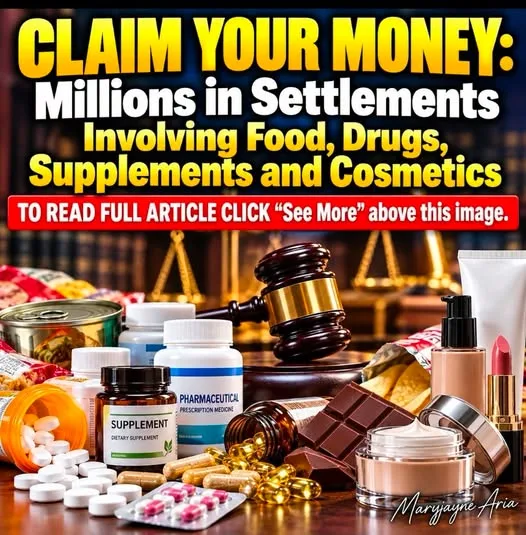
I started looking into class action settlements because I wanted to know just how much money is potentially sitting in settlement funds because of products people have bought, consumed or put on their bodies. What I found surprised me. There are multi millions of dollars involved in settlements concerning pharmaceuticals, supplements, cosmetics, personal care products and food, while at the same time a completely different group of cases is being filed over alleged contamination, misleading labels, undisclosed ingredients and health claims. I began with SettlementFinder, but I did not want to rely on one settlement website alone. I also looked at current information from ClassAction.org and other settlement resources because I wanted to separate genuine settlement opportunities from lawsuits that are still only allegations.
AND THIS IS WHERE IT GETS INTERESTING: Many of these cases involve multi millions of dollars. Others involve a relatively small payment to an individual consumer. Some are already approved settlements with a claim process. Others are proposed settlements awaiting final court approval. And then there are active lawsuits in which consumers are alleging that a product was misrepresented or contained something they did not expect.
THE MONEY IS REAL, BUT SO ARE THE RULES: If you qualify for a settlement, you generally have to fall within the legally defined class and meet the requirements in the settlement agreement. You cannot simply claim because you once bought a similar product. Some settlements require proof of purchase. Others allow claims without receipts. Some payments are fixed, while others are divided among all valid claimants, meaning the final amount cannot be known until the claims process is complete.
HERE ARE 40 FOOD, PHARMACEUTICAL, SUPPLEMENT AND COSMETIC CASES THAT CAUGHT MY ATTENTION:
1. CHANTIX: Pfizer agreed to a $44 million settlement resolving litigation alleging that Chantix contained an undisclosed nitrosamine described in the litigation as a probable human carcinogen. The settlement covers qualifying U.S. retail purchases between September 29, 2015 and September 17, 2021. Eligible claimants receive a pro-rata share based on what they paid, subject to the settlement terms.
2. VSL#3: A $20 million settlement resolves litigation alleging that reformulated VSL#3 was marketed as the original clinically tested product. Eligible purchasers between June 1, 2016 and June 19, 2019 can claim $20 per unit, with qualifying proof of purchase allowing claims for up to 40 units, potentially $800.
3. DR. SQUATCH: A $9 million settlement resolves allegations that certain personal-care products marketed as "natural" contained synthetic ingredients. This is a particularly interesting case because the dispute centres on what consumers were told they were buying versus what the lawsuit alleged was actually in the products.
4. NEUTROGENA SKIN360: A $4.7 million settlement concerns allegations that Johnson & Johnson Consumer unlawfully collected and stored facial scans through its Skin360 system in violation of Illinois biometric privacy law. The settlement website is now live, and eligible Illinois users can submit claims by November 25, 2026.
5. ATHENA COSMETICS: A $4.17 million settlement resolves allegations involving RevitaLash and RevitaBrow lash and brow serums and claims that certain potentially harmful side effects were not adequately disclosed. The settlement provides cash and vouchers to qualifying purchasers.
6. NUTRICOST MAGNESIUM GLYCINATE: A $1.83 million settlement concerns allegations that certain Nutricost magnesium glycinate supplements were misleadingly labelled. The settlement covers qualifying purchases from February 1, 2021 through June 8, 2026, and valid claimants can receive an award unit worth no more than $19.95 per qualifying supplement purchase.
7. BAYER ANTIFUNGAL SPRAYS: Litigation concerning certain Bayer antifungal sprays included allegations involving benzene contamination and resulted in a settlement. This is one of the pharmaceutical and personal-care cases I think deserves attention because contamination allegations involving a chemical such as benzene are fundamentally different from an ordinary labelling dispute.
8. DIFFERIN ACNE TREATMENTS: A settlement involving Differin concerned allegations that certain acne-treatment products were contaminated with benzene. Again, I want to stress that the allegation and the settlement should not be interpreted as proof that every Differin product was contaminated or that every user was harmed.
9. STRIDES TESTOSTERONE GEL: Litigation involving Strides testosterone gel included allegations of benzene contamination and resulted in a settlement exceeding $750,000. The case is another example of why pharmaceutical contamination litigation deserves careful attention.
10. TOM'S OF MAINE TOOTHPASTE: A $2.9 million settlement resolved litigation concerning allegations of contamination involving certain Tom's of Maine toothpaste products. This is particularly interesting to me because toothpaste is such an everyday product that most people would never think to investigate its litigation history.
11. SWEET BABY RAY'S: A lawsuit filed in September 2026 alleges that certain Sweet Baby Ray's "No Sugar Added" sauces, dipping sauces and marinades are misleadingly advertised because they contain allulose. The complaint argues that consumers would not necessarily understand from the front label that allulose was being added. This is an active lawsuit, not a settlement, and the allegations have not been established by a court.
12. KIND DARK CHOCOLATE CLUSTERS: A proposed class action alleges that certain KIND Healthy Grains Dark Chocolate Clusters contain more lead than represented and alleges levels exceeding a referenced maximum allowable dose. These are allegations in litigation, not a court finding.
13. KIND ZEROg ADDED SUGAR BARS: Another lawsuit alleges that certain KIND nut bars marketed as containing "ZEROg Added Sugar" contain added sugar. This case illustrates how a few words on the front of a packet can become the centre of a legal dispute.
14. BOULDER CANYON AND GOOD HEALTH AVOCADO OIL CHIPS: A lawsuit alleges that certain Utz potato chips marketed as avocado-oil products are made using a diluted blend of oils rather than exclusively avocado oil.
15. DRISCOLL'S STRAWBERRIES: A proposed class action alleges that Driscoll's failed to disclose the presence of PFAS, commonly known as "forever chemicals," in strawberries. This remains an allegation in litigation.
16. ORGAIN ORGANIC PROTEIN POWDER: A lawsuit against Costco alleges that certain Orgain Organic Protein Powder products contain lead, cadmium and arsenic and that the alleged presence of those substances was not adequately disclosed. The complaint says independent testing detected the metals in some or all samples tested. These are allegations, not an established court finding.
17. GREAT VALUE ORGANIC CHIA SEEDS: A lawsuit alleges that Walmart's Great Value Organic Chia Seeds contain excessively high levels of mold and that consumers were not adequately warned.
18. NARA ORGANICS INFANT FORMULA: A lawsuit alleges that recalled Nara Organics infant formula may have been contaminated with bacteria capable of causing infant botulism. Because infant formula is consumed by babies, this is one of the cases that immediately made me stop and read more carefully. The allegations should not be confused with a final court finding.
19. VERACITY "NATURE'S OZEMPIC": A lawsuit alleges that Veracity marketed Metabolism Ignite supplements as producing results similar to prescription GLP-1 drugs without their side effects. This is an allegation about marketing claims and is not evidence that the supplement does or does not work.
20. OLLY KIDS SLEEP: A lawsuit alleges that OLLY Kids Sleep melatonin supplements were misleadingly marketed and raises allegations concerning their safety for children. Again, these are allegations contained in litigation and should not be presented as established facts.
21. RITUAL MULTIVITAMINS: A lawsuit alleges that Ritual Essential multivitamins do not contain all 13 vitamins consumers might associate with the phrase "essential vitamins." This is another example of a dispute over marketing and consumer expectations rather than a finding that the product is inherently unsafe.
22. ONE A DAY MEN'S PRE-CONCEPTION HEALTH: A lawsuit alleges that Bayer's One A Day Men's Pre-Conception Health multivitamins make misleading representations concerning sperm health. This remains a legal allegation.
23. AIRBORNE VITAMIN C: A lawsuit alleges that certain Airborne vitamin C supplements contain less vitamin C per unit than consumers were led to believe by the product labelling.
24. RAW NUTRITION RAW ISOLATE: A lawsuit alleges that Raw Nutrition's Raw Isolate protein products contain less protein per serving than advertised. The case is another example of the importance of distinguishing what the label promises from what a lawsuit alleges the laboratory results show.
25. MATCHABAR CEREMONIAL GRADE MATCHA: A lawsuit alleges that MatchaBar's ceremonial-grade matcha does not meet the quality consumers would reasonably expect from that description.
26. CAPATRITI OLIVE OIL: A lawsuit alleges that certain Capatriti products marketed as extra virgin olive oil contain cheaper refined oils. This is an allegation concerning authenticity and labelling.
27. ARIZONA TEA AND JUICE: A lawsuit alleges that certain Arizona beverages marketed as "natural" contain synthetic ingredients. The case illustrates the continuing legal debate surrounding the meaning and consumer interpretation of the word "natural."
28. CHOLULA ORIGINAL HOT SAUCE: A lawsuit alleges that McCormick secretly reformulated Cholula Original Hot Sauce using cheaper ingredients without adequately informing consumers.
29. SEEDS OF CHANGE ORGANIC QUINOA AND RICE: A lawsuit alleges that certain products contain less quinoa than consumers would reasonably expect based on the product name and marketing.
30. LIQUID I.V. SUGAR FREE: A lawsuit alleges that certain Liquid I.V. products labelled "sugar free" contain allulose and challenges whether that representation is misleading.
31. HALFDAY TONICS: A lawsuit alleges that certain prebiotic iced teas contain more sugar than consumers would expect from their marketing.
32. COVE PROBIOTIC SODAS: A lawsuit alleges that certain Cove probiotic drinks advertised as containing "No Artificial Sweeteners" contain synthetic erythritol.
33. GATORADE: A lawsuit challenges various Gatorade representations concerning artificial ingredients and hydration claims. These are allegations, not findings that the marketing is unlawful.
34. TRADER JOE'S LOW ACID COFFEE: A lawsuit alleges that Trader Joe's Low Acid Dark French Roast Coffee is more acidic than consumers would reasonably expect from the "low acid" representation.
35. CAMPBELL'S MICROWAVABLE SOUP: A lawsuit alleges that Campbell's microwavable soup containers can release microplastics into food during heating. This remains an allegation being litigated.
36. SENSIBLE PORTIONS VEGGIE PUFFS AND STRAWS: A lawsuit alleges that certain products are misleadingly marketed as containing no artificial preservatives.
37. NATURE'S BAKERY FIG BARS: A lawsuit challenges representations concerning the natural and wholesome qualities of certain Nature's Bakery products.
38. LAIRD SUPERFOOD PROTEIN BARS: A lawsuit alleges that Laird Superfood protein bars do not contain protein as their primary macronutrient despite the way the products are marketed.
39. OPTASE EYE TREATMENTS: A lawsuit alleges that certain OPTASE eye treatments are misbranded because they contain active ingredients that are not FDA-approved. This is an allegation in litigation and should not be described as an FDA determination.
40. REFRESH TEARS PF: A lawsuit alleges that Allergan's Refresh Tears PF eye drops are falsely advertised as "preservative-free" because they contain boric acid, which the lawsuit characterizes as a bacteria-halting preservative. Again, this is an allegation, not a court finding.
WHAT I FIND MOST STRIKING: Look at the range. Prescription medicine. Probiotics. Magnesium supplements. Protein powders. Multivitamins. Eye drops. Acne treatments. Testosterone gel. Toothpaste. Shampoo. Lash serums. Strawberries. Infant formula. Olive oil. Hot sauce. Coffee. Sports drinks. This is not one isolated corner of the consumer market. These are ordinary products that people buy because they trust the label, the brand, the retailer or the health claims attached to them.
AND THEN THERE IS THE MONEY: The settlements alone represent millions upon millions of dollars. The Chantix settlement is $44 million. VSL#3 is $20 million. Dr. Squatch is $9 million. Neutrogena Skin360 is $4.7 million. Athena Cosmetics is $4.17 million. Nutricost is $1.83 million. These figures do not mean that every consumer receives a huge cheque. Settlement funds are divided according to the terms of each case, and some payments are pro-rata. But they demonstrate the enormous sums involved when large numbers of consumers become part of litigation.
WHAT I WOULD DO: I would search settlement databases regularly, particularly if I buy a lot of supplements, medicines, cosmetics or packaged food. I would keep receipts and online purchase confirmations whenever possible. I would never submit a claim simply because a product name appears on a list. I would read the actual eligibility requirements and, where a settlement is available, use the official settlement administrator rather than relying solely on a third-party website.
USEFUL LINKS TO CHECK
BUT I KEEP COMING BACK TO ONE QUESTION: How many people actually know that these cases exist? A person may have purchased a product for years, thrown away the packaging and never have any idea that a lawsuit was filed concerning it. Unless they happen to see a settlement notice or search for one, they may never know that they could potentially be part of a class.
THAT IS WHY I WANTED TO WRITE THIS: Not to tell anyone that a particular product is dangerous, and not to tell anyone to make a claim they are not entitled to make. I want people to understand that there is an enormous legal trail behind many of the products we consume and apply to our bodies. Some allegations ultimately result in settlements. Some cases are dismissed. Some remain unresolved. Some claims may lead to regulatory action or recalls. The only responsible way to look at them is to examine what was actually alleged, what evidence was presented, what the company said in response and what ultimately happened in court.
FOR ME, THE MOST IMPORTANT THING IS KNOWING WHAT IS BEHIND THE LABEL: When a package says "natural," "sugar free," "clinically tested," "preservative free," "high protein," "organic" or "safe," those words influence what consumers choose and what they are willing to pay. When those representations become the subject of litigation, I think consumers have every reason to pay attention. And if you have bought products covered by an actual settlement, check the official settlement website and the deadline. You may be entitled to compensation, but you need to establish that you genuinely qualify.
Please share this article without making any changes to help increase awareness.
Copyright Maryjayne Aria , author of Immune Health, Terrain and GcMAF.