For years, the public has been encouraged to place its trust in scientific research, particularly when it comes to cancer. Research papers influence treatment guidelines, direct billions of dollars in funding, shape future studies, and ultimately affect the lives of millions of patients.
But what happens when that research is found to contain serious flaws?
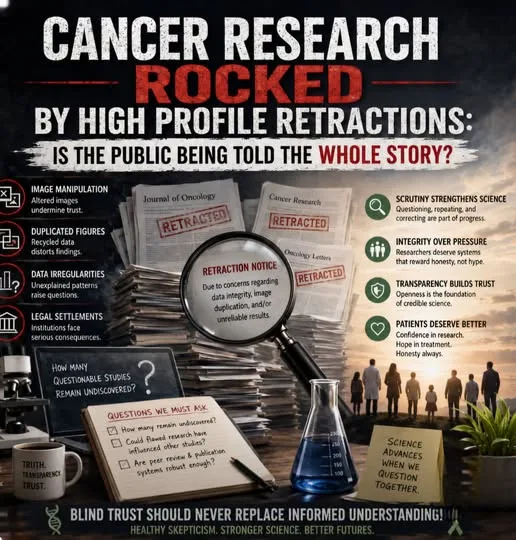
In recent years, a growing number of high profile cancer research papers have been corrected or retracted after serious concerns were raised about image manipulation, duplicated figures, data irregularities, and other issues affecting research integrity. The world's leading cancer research institutions have been forced to investigate published studies, while legal settlements related to research practices have intensified public debate.
These developments have prompted difficult but important questions.
1. How many questionable studies remain undiscovered?
2. Could flawed research have influenced other studies that relied on those findings?
3. Are the current peer review and publication systems robust enough to detect problems before research enters the scientific literature?
These cases remind us that scientific publishing is not infallible. Peer review is an important safeguard, but it is not designed to detect all errors or every instance of misconduct. Increasingly, independent researchers, image analysts, and watchdog organizations are uncovering problems years after papers were first published.
Science advances by building upon previous discoveries. When foundational studies are later questioned or withdrawn, it creates uncertainty and require other researchers to re-examine work that has been based upon flawed data. This does not mean that all subsequent research is invalid, but it does demonstrate why scientific transparency is so important.
It is also worth remembering that the overwhelming majority of scientists dedicate their careers to improving human health with honesty and professionalism. These researchers are just as concerned about research misconduct as the public because unreliable science damages confidence in the entire scientific community and can divert valuable time, funding, and resources.
Perhaps the greatest lesson from these events is that science is strongest when it welcomes scrutiny rather than avoiding it. Questioning evidence, repeating experiments, correcting mistakes, and retracting flawed work are all essential parts of the scientific process. Transparency should never be viewed as a threat. It is one of the foundations of credible science.
Patients facing a cancer diagnosis deserve confidence that the research informing their care has been rigorously examined. Families deserve openness. Researchers deserve systems that reward integrity rather than publication pressure. Above all, the public deserves honesty.
Blind trust should never replace informed understanding. Healthy skepticism, supported by evidence and respectful debate, strengthens science rather than weakening it.
Written by Maryjayne Aria Author of Immune Health and Terrain