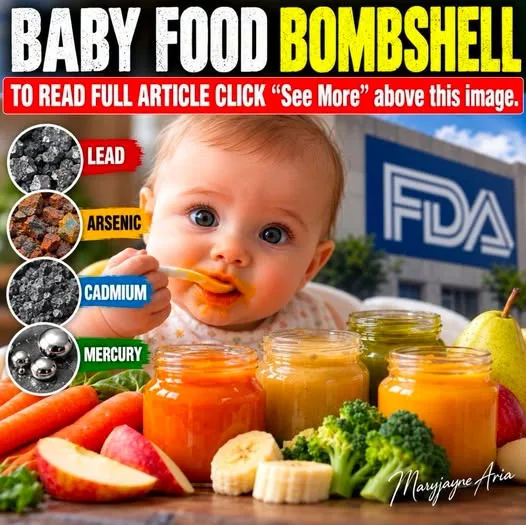
I have spent years researching environmental toxins and how repeated low-level exposure can affect the human body, particularly during vulnerable stages of development. So when I look at the continuing controversy surrounding heavy metals in baby food, I do not see this as simply another regulatory debate. I see babies being repeatedly exposed to substances such as lead, arsenic, cadmium and mercury, and I see a regulatory system that, in my opinion, has been far too slow to respond. This is one of those subjects that genuinely keeps me awake at night.
FOR ME, THERE ARE NO GREY AREAS ON THE CENTRAL QUESTION: Can a small amount of a toxic heavy metal cause serious harm? YES. Lead is a recognised neurotoxic substance, children are particularly vulnerable, and there is no identified safe blood lead level for children. The idea that exposure automatically becomes harmless simply because a regulatory threshold has not been exceeded is something I fundamentally reject.
AN FDA ACTION LEVEL IS NOT A SAFE LEVEL: This distinction is absolutely crucial. The FDA itself states that action levels do not establish a permissible level of contamination. Its current guidance says action levels are regulatory tools used to help reduce contamination where some environmental contamination may be unavoidable. For processed foods intended for babies and young children, the FDA's 2025 lead guidance established action levels of 10 parts per billion for many categories and 20 parts per billion for certain root vegetables and dry cereals. To me, that raises a very simple question: if the objective is to protect developing babies, why should we ever confuse a regulatory action point with biological safety?
LEAD AND THE DEVELOPING BRAIN: Lead exposure is particularly concerning because the developing nervous system is vulnerable to its effects. The FDA itself identifies lead as one of the toxic elements it is working to reduce in foods eaten by babies and young children, alongside arsenic, cadmium and mercury. These substances do not belong in a baby's diet because a regulator has decided that some level may be unavoidable. The scientific and public-health goal should surely be continual reduction wherever contamination can be prevented.
NOW CONSIDER THIS HYPOTHETICAL COMPARISON: I want to make my point very clear because I am not suggesting that a mother deliberately giving a baby lead is legally the same as a manufacturer selling a contaminated product. I am asking whether we would judge the underlying exposure differently simply because of who provided it. Imagine a mother knowingly gave her baby a small amount of lead every day, repeatedly, because she believed the amount was "acceptable." Now imagine that mother standing before a jury and saying, "I checked the regulations. The amount I gave my baby was below the FDA action level." Would the jury simply accept that as proof that the exposure was safe? Or would they ask why she was repeatedly exposing her baby to a known toxic substance in the first place, particularly if the child was subsequently harmed? I cannot predict what a jury would decide, but the underlying scientific question remains: does being below an FDA action level automatically mean an exposure is harmless? NO. Even the FDA says action levels do not establish a permissible level of contamination.
I HAVE NO CONFIDENCE IN THE FDA: I want to say this plainly because it is my personal position. I do not have confidence that the FDA is sufficiently independent when it comes to protecting the public from contaminated food. I believe there are interests operating around the regulatory system that can influence what is considered acceptable, how quickly action is taken and how much contamination is tolerated. I also believe the public deserves far greater transparency about those influences. Based on what I see in the regulatory system, I do not trust the FDA to be the final authority on whether something is safe for a baby.
WHY DO I QUESTION ITS INDEPENDENCE? There are documented reasons why questions about independence and transparency deserve scrutiny. A 2026 U.S. Government Accountability Office review found that FDA funding increased substantially from 2008 to 2024, with much of the increase coming from user fees paid by the manufacturers the agency regulates. The GAO has also recently reported that FDA had not finalized guidance explaining how it determines financial conflicts of interest for advisory committee members and did not publicly explain how those decisions are made. This demonstrate why I believe the public is entitled to ask difficult questions about independence, transparency and potential conflicts.
I BELIEVE THE FDA ACTS TOO LATE: This is another major reason I have lost confidence. The FDA announced its Closer to Zero action plan in 2021, yet final guidance establishing action levels for lead in processed foods for babies and young children did not arrive until January 2025. The FDA now says it is continuing work on contaminants including cadmium and inorganic arsenic, with further action levels being developed. From my perspective, when we are talking about babies and developing brains, years of gathering data, consultation and regulatory discussion feels painfully slow. I believe action should happen before widespread exposure becomes the evidence that finally forces action.
THIS PROBLEM DID NOT BEGIN WITH THE CURRENT LAWSUITS: The issue of heavy metals in baby food has been investigated for years. The FDA has tested foods for arsenic, lead, cadmium and mercury as part of its surveillance and regulatory work, including foods commonly eaten by young children. The FDA's own Closer to Zero programme acknowledges that these contaminants can enter food through soil, water and air and states that its goal is to reduce dietary exposure as low as possible. That raises another question for me: if we already know these substances are toxic and we know they can enter the food chain, why isn't the standard simply continual reduction toward the lowest technically achievable contamination?
AND THE TESTING HAS NOT STOPPED: Independent testing continues to raise great concerns about contaminants in commercially produced baby foods. This matters because parents are not buying laboratory samples. They are buying finished products and feeding them directly to their children. I want to know exactly what is in those finished products, how frequently they are tested, what concentrations are detected, whether different batches produce different results and what happens when concerning levels are found.
THEN THERE IS THE LEGAL BATTLE: Hundreds of baby-food cases have been consolidated into federal multidistrict litigation in California involving allegations concerning toxic heavy metals and children's exposure. Parents deserve transparent information about contamination and exposure.
WHY HAVE THE PRODUCTS NOT SIMPLY BEEN SHUT DOWN? Because private lawsuits and regulatory enforcement are separate processes. The existence of detectable contamination does not automatically mean every product is legally prohibited from sale. The FDA says it can take enforcement action when food violates applicable safety laws and does not necessarily need a specific action level before acting. But this is precisely where my concern remains. What I want to know is whether the regulatory system is acting as early and aggressively as it possibly can when vulnerable babies are involved.
AND THIS IS WHERE PROFITS ENTER MY THINKING: I am accusing particular manufacturers of deliberately putting profits before children's health. My concern is also broader. The FDA openly considers whether proposed contamination limits are achievable by industry, and its Closer to Zero process includes consultation with stakeholders and consideration of feasibility. I question how much weight commercial feasibility should ever have when the people being protected are babies. I cannot help asking whether economics influence what becomes acceptable.
A BABY HAS NO CHOICE: A baby cannot read a label, examine laboratory results, research toxicology or decide which brand to buy. The baby relies completely on adults and institutions to protect them. That places an enormous responsibility on regulators and manufacturers. For me, "probably acceptable" is not the standard I want applied to an infant's developing brain.
I WANT THE ACTUAL TEST RESULTS: I want independent testing of finished baby-food products. I want clear disclosure of lead, arsenic, cadmium and mercury concentrations. I want testing to be repeated rather than treating one laboratory result as the final answer. I want batch numbers, dates, methods and results made transparent. Most importantly, I want parents to be able to see the evidence for themselves rather than being told simply to trust a regulatory agency. I want zero contaminants allowed in food for all.
THIS IS WHAT KEEPS ME AWAKE AT NIGHT: We are talking about vulnerable developing brains and bodies. We know that environmental contaminants can enter food. We know lead is toxic. We know children are particularly vulnerable. We know regulatory action levels are not guarantees of biological safety. We also know that the FDA itself says its goal is to reduce exposure to contaminants as low as possible. So why should I be satisfied with anything less than relentless pressure to stop contamination?
SO I WILL KEEP ASKING THE QUESTION: If a small amount of a toxic substance can cause harm, why should the public be expected to treat a regulatory threshold as reassurance? Why should parents have to rely entirely on the same system that establishes the thresholds? Why shouldn't independent laboratories, researchers and consumer organisations be scrutinising these products continuously? And why, when the potential victims are babies, does regulatory action take years?
I have no confidence in the FDA to simply tell me that a level is "acceptable" and expect me to stop asking questions. I believe the public should question regulators, manufacturers and the entire system whenever children's health is involved. I believe transparency should come before reassurance, independent testing should come before trust, and prevention should come before damage control. Most importantly, I believe that when we are feeding babies, "within the regulatory limit" should never be confused with "safe."
Please share this information to help increase awareness.
Copyright Maryjayne Aria, author of Immune Health, Terrain and GcMAF.