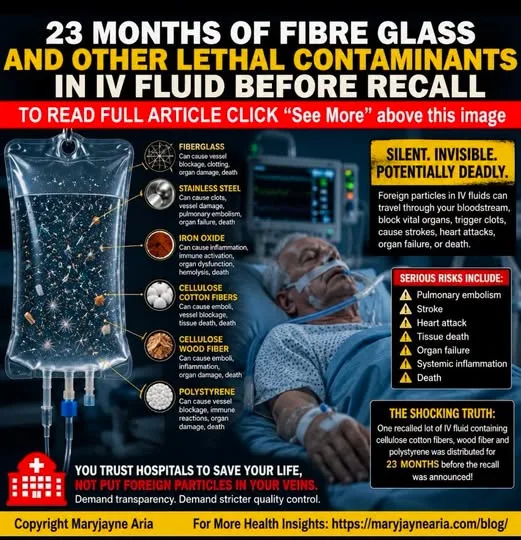
23 MONTHS OF FIBRE GLASS AND OTHER LETHAL CONTAMINANTS IN IV FLUID BEFORE RECALL
Intravenous products containing fiberglass, stainless steel, iron oxide, cotton-derived cellulose fibers, wood-derived cellulose fibers and polystyrene, are not substances a patient expects to enter directly into the bloodstream. Foreign material infused into a vein can block blood vessels, trigger clotting and inflammation, damage organs and be lethal. The manufacturers' own FDA-posted risk statements describe pulmonary embolism, permanent organ damage and death among the potential consequences of particulate contamination in these recalled products.
A CRITICAL FACT ABOUT THE 23-MONTH DELAY: The most shocking timeline is that it took for 23 months for the IV bags to be recalled. The documented 23-month gap relates to a recalled lot of B. Braun Excel® Lactated Ringers Injection containing particulate matter identified primarily as fiberglass, stainless steel, iron oxide, cellulose cotton fibers, with individual particles identified as cellulose wood fiber and polystyrene. The affected lot was distributed between August 29 and September 30, 2024, yet the public recall announcement was not issued until August 19, 2026. That means an affected product entered distribution almost 23 months before the public recall.
FIBERGLASS IN AN IV FLUID CAN BE DEADLY: On August 25, 2026, Baxter announced a nationwide recall of two lots of 0.9% Sodium Chloride Injection because of the potential presence of particulate matter identified as fiberglass. According to the FDA-posted recall announcement, intravenous administration of contaminated saline can cause blockage and clotting in blood vessels, potentially cutting off blood flow to vital organs. The manufacturer's risk statement specifically warns that particulate contamination may lead to a life-threatening pulmonary embolism, permanent organ damage or death. The notice also warns of local vein irritation, inflammatory reactions, aggravation of preexisting infections and allergic reactions. These warnings are particularly alarming because saline is one of the most commonly used intravenous fluids in hospitals.
STAINLESS STEEL PARTICLES WERE ALSO IDENTIFIED IN AN INTRAVENOUS PRODUCT: In another August 2026 recall, Baxter recalled one lot of 70% Dextrose Injection because of the potential presence of stainless steel particles. This product is used in parenteral nutrition for patients who cannot obtain adequate nutrition through normal eating or enteral feeding. These may include seriously ill and medically vulnerable patients. The manufacturer's risk statement again warned that particulate matter can cause blockage and clotting in blood vessels, potentially cut off blood flow to vital organs, cause a life-threatening pulmonary embolism and result in permanent organ damage or death. The idea that a seriously ill patient may receive nutrition through an intravenous system while the product itself is being recalled because of potential metal particles is a deeply disturbing example of why injectable product quality control must be exceptionally rigorous.
IRON OXIDE PARTICLES WERE FOUND IN SALINE: B. Braun also recalled many of 0.9% Sodium Chloride Injection after particulate matter was identified as iron oxide. The FDA-posted risk statement said administration of particulate-contaminated saline had a reasonable probability of causing life-threatening adverse health consequences, including pulmonary emboli and occlusions of other blood vessels, potentially leading to tissue death and organ damage. The company also warned that foreign particles infused intravenously can cause systemic immune activation, organ dysfunction and hemolysis, meaning the breakdown of blood cells. Iron oxide may have legitimate uses in other settings, but unidentified foreign particles are not supposed to be present in an IV solution intended to enter a patient's circulation.
COTTON AND WOOD FIBERS MAY SOUND NATURAL, BUT THEY DO NOT BELONG IN A VEIN: The 23-month distribution-to-public-recall timeline involved particulate matter identified primarily as cellulose cotton fibers, with individual particles identified as cellulose wood fiber and polystyrene. Calling something natural or plant-derived does not make it safe to infuse into a bloodstream. A cotton or wood-derived fiber swallowed by mouth is not comparable to a foreign particle entering directly into the circulatory system. According to B. Braun's FDA-posted risk statement, the defective product had a reasonable probability of causing pulmonary emboli, occlusions of other blood vessels that could lead to tissue death and possible organ damage, and phlebitis. The company also warned that foreign particles infused intravenously can cause systemic immune activation, organ dysfunction and hemolysis.
POLYSTYRENE ADDS ANOTHER DISTURBING DIMENSION: Polystyrene, a synthetic plastic material, was also individually identified among the particulate matter in the recalled Lactated Ringers product. The danger described in the recall is not simply about the chemical name of the material. Any foreign particle entering the bloodstream can potentially create a mechanical problem by travelling through the circulation and lodging in smaller blood vessels. The manufacturer's risk statement warned of pulmonary emboli, vascular occlusions, tissue death, possible organ damage and phlebitis, as well as systemic immune activation, organ dysfunction and hemolysis. This does not mean that every microscopic particle will produce these outcomes, but it demonstrates why particulate contamination in an injectable solution is treated as a potentially serious safety event.
WHAT COULD ACTUALLY HAPPEN INSIDE THE BODY? Once foreign particulate material enters a vein, it bypasses the protective barriers of the skin and digestive system and enters the circulation. Larger particles may obstruct blood vessels, while smaller particles may travel deeper into the microcirculation. Their physical shape may irritate blood-vessel walls, while the presence of foreign material may contribute to inflammation and activation of clotting mechanisms. Particles and associated clots may potentially travel to the lungs, where obstruction of pulmonary blood vessels can become life-threatening. If blood flow to tissue is interrupted, tissue damage and organ injury may occur. The severity is influenced by particle size, number, shape, composition and the health of the patient receiving the contaminated product.
FOR A SERIOUSLY ILL PATIENT, THE RISK MAY BE MORE SERIOUS: Hospital patients receiving IV fluids are often not healthy people receiving routine hydration. They may have severe infections, cancer, kidney failure, heart disease, major trauma, burns, surgical complications, malnutrition or other life-threatening conditions. Some may already have impaired circulation, inflammation, increased clotting risk or damaged organs. A patient whose lungs are already struggling may have less capacity to tolerate additional obstruction in the pulmonary circulation. A patient with organ failure may have less reserve to withstand further injury. Newborns and critically ill infants may be particularly vulnerable because of their extremely small blood vessels and limited physiological reserve.
COULD THESE CONTAMINANTS KILL? YES, Baxter's own risk statements for the fiberglass and stainless steel recalls explicitly warn that particulate contamination may cause a life-threatening pulmonary embolism, permanent organ damage or death. B. Braun's notices describe a reasonable probability of life-threatening adverse health consequences from particulate contamination, including pulmonary emboli, blood-vessel occlusions, tissue death and organ damage. The possibility of death was very serious, enough to be included in the manufacturers' official risk assessments.
THE WORD "STERILE" DOES NOT MEAN THE SAME THING AS "PARTICLE-FREE": A sterile product is intended to be free of viable microorganisms, but particulate control is a separate and equally important aspect of injectable product quality. An IV solution can potentially be microbiologically sterile while still having an unacceptable foreign particulate problem. That is why visible and subvisible particle control, manufacturing conditions, filtration, container integrity, equipment maintenance and final inspection are all important in injectable pharmaceutical production.
WHAT CAUSED THESE PARTICLES TO ENTER THE PRODUCTS? This is where the public information becomes frustratingly incomplete. The recall announcements identify the particles or potential particles, but they do not publicly provide a confirmed, detailed root cause for every incident. The notices do not establish whether the contamination came from equipment, manufacturing processes, filters, packaging, raw materials, environmental contamination or another failure. It would be irresponsible to invent an explanation without evidence. However, identifying the contaminant is only one part of the story. Patients and the public also deserve to know how it entered a product intended for intravenous use, when it was first detected and what corrective action is being taken to prevent the same type of contamination from happening again.
THE 23-MONTH QUESTION IS THE ONE THAT DEMANDS ANSWERS: The affected Lactated Ringers lot was distributed in late August and September 2024 and publicly recalled in August 2026. It establishes a nearly 23-month gap between distribution and the public recall announcement. That raises serious questions. When was the particulate matter first discovered? Was it found during routine testing, through a complaint, an inspection or another investigation? How many units were distributed and used before the recall? Were there earlier warning signs? Could the contamination have been detected sooner? These are not conspiracy theories. They are reasonable patient-safety questions that arise whenever a product intended for direct intravenous administration is later recalled because foreign particles were found inside it.
THIS WAS NOT JUST ONE PRODUCT: The FDA's drug recall listings for August 2026 show multiple injectable-product recalls involving different forms of particulate contamination. The list included fiberglass in 0.9% Sodium Chloride Injection and sodium citrate solution, stainless steel particles in 70% Dextrose Injection, iron oxide in sodium chloride, and cotton-derived cellulose fibers, wood-derived cellulose fibers and polystyrene in Lactated Ringers. The products, materials and manufacturers were not identical, which means the incidents should not automatically be treated as one single contamination event. Yet from a patient's perspective, they all lead back to the same fundamental concern: why is foreign particulate matter reaching products intended to enter the human bloodstream?
THE MOST SHOCKING PART MAY BE HOW MUCH TRUST IS INVOLVED: A patient connected to an IV usually has no practical way to independently inspect every microscopic particle entering their body. They rely on manufacturers, quality-control laboratories, hospitals, regulators and healthcare professionals to ensure that the solution in the bag meets strict standards. A clear bag of fluid can look completely ordinary while containing a problem that may only be discovered later. This is why the responsibility for preventing particulate contamination must rest primarily on the systems designed to detect and stop it before the product reaches a patient's bedside.
THE REAL QUESTION IS NOT WHETHER PEOPLE SHOULD PANIC: Contamination of these types should not be dismissed as insignificant. The manufacturers' own risk statements make clear that foreign particles infused intravenously can, under certain circumstances, cause life-threatening pulmonary embolism, vascular occlusion, tissue death, organ dysfunction and death. It is transparency, investigation, stronger quality control and serious questions about whether existing systems are detecting contamination quickly enough.
FINAL THOUGHT: A hospital patient should never have to wonder whether the clear fluid entering their vein contains fiberglass, metal, iron oxide, cotton fibers, wood-derived fibers or plastic particles. The documented recalls show that particulate contamination can occur, and the documented 23-month distribution-to-public-recall gap involving one affected Lactated Ringers lot raises particularly uncomfortable questions about detection and oversight. Manufacturers themselves warned that particulate contamination in intravenous products could potentially lead to life-threatening pulmonary embolism, permanent organ damage and death. That is why these recalls deserve attention. The question is not simply what was found. The question is how foreign material entered products intended for the bloodstream, when the problem was discovered and whether every possible safeguard was strong enough to protect the patients who trusted those products with their lives.
Please share this information without making any changes to help increase awareness