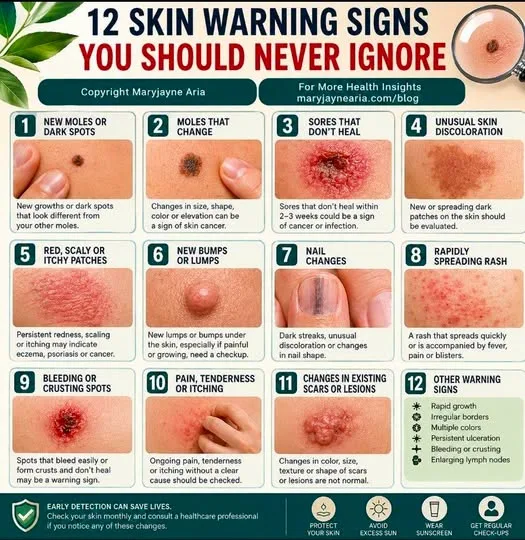
Early Detection Could Save Your Life:
Your skin is the body's largest organ and often provides early clues that something is not right. While many skin changes are harmless, others may be the first sign of skin cancer, chronic inflammation, autoimmune disease, infection, or metabolic disorders. Learning to recognize these warning signs can help you seek medical advice sooner, when treatment is often simpler and more effective.
1. New Moles or Dark Spots
A new mole that appears during adulthood or one that looks noticeably different from your other moles deserves attention.
Watch for:
• New growth after age 30
• Dark or uneven pigmentation
• Rapid enlargement
• Different appearance from surrounding moles
2. Moles That Change:
The ABCDE rule is a useful guide.
• A: Asymmetry
• B: Irregular Borders
• C: Multiple or uneven Colours
• D: Diameter greater than 6 mm
• E: Evolving over time
Changes in shape, colour, size or elevation should always be assessed by a healthcare professional.
3. Sores That Do Not Heal:
Any sore that remains open, repeatedly bleeds, crusts, or fails to heal after 2 to 3 weeks should be examined.
Possible causes include:
• Basal cell carcinoma
• Squamous cell carcinoma
• Chronic infection
• Poor circulation
• Diabetes
4. Unusual Skin Discolouration:
Dark or irregular patches that continue to spread may require medical evaluation.
Potential causes include:
• Melanoma
• Hormonal disorders
• Chronic inflammation
• Medication reactions
• Fungal infections
5. Persistent Red, Scaly or Itchy Patches:
Persistent inflammation may indicate:
• Psoriasis
• Eczema
• Fungal infections
• Autoimmune disease
• Early skin cancer
Do not ignore areas that continue to worsen despite moisturisers.
6. New Bumps or Lumps:
New growths beneath the skin may represent:
• Cysts
• Lipomas
• Enlarged lymph nodes
• Skin tumours
• Infections
Any lump that grows quickly, becomes painful, or changes should be assessed.
7. Nail Changes:
The nails often reveal important health information.
Warning signs include:
• Dark streaks
• Thickened nails
• Nail separation
• Persistent discolouration
• Changes in nail shape
In rare cases, melanoma can develop beneath the nail.
8. Rapidly Spreading Rash:
Seek prompt medical attention if a rash is accompanied by:
• Fever
• Blistering
• Severe pain
• Rapid spread
• Difficulty breathing
Some severe allergic reactions and infections require urgent treatment.
9. Bleeding or Crusting Spots:
A spot that repeatedly bleeds, forms a crust, heals, and then returns should never be ignored.
These changes are commonly associated with certain forms of skin cancer.
10. Pain, Tenderness or Persistent Itching:
Ongoing discomfort without an obvious cause may indicate:
• Chronic inflammation
• Infection • Nerve irritation
• Allergic reactions
• Skin cancer
Persistent itching around a mole or lesion deserves evaluation.
11. Changes in Existing Scars or Lesions:
Scar tissue should generally remain stable.
Medical review is recommended if a scar develops:
• New lumps
• Colour changes
• Bleeding
• Ulceration
• Rapid enlargement
12. Other Important Warning Signs
Seek medical advice if you notice:
• Rapid growth
• Irregular borders
• Multiple colours
• Persistent ulceration
• Bleeding
• Recurring crusting
• Increasing pain
• Enlarging lymph nodes
Who Is at Higher Risk?
Risk factors include:
• Excessive sun exposure
• Fair skin
• Family history of skin cancer
• Previous skin cancer
• Weakened immune system
• Frequent sunburns
• Increasing age
Natural Products That May Support Healthy Skin:
Natural products should complement, not replace, medical evaluation and evidence-based treatment for suspicious skin lesions.
Some nutrients and botanicals that support skin health include:
• Vitamin D3 and Vitamin K2
• Vitamin C
• Zinc • Selenium
• Omega 3 fatty acids
• Curcumin • Green tea extract
• Aloe vera gel
• Calendula • Gotu kola
• Medical-grade honey for appropriate wounds
• Probiotics to support immune and gut health
• GcMAF Cream with Saffron
GcMAF cream containing saffron has been explored with good results as a topical product intended to support skin health and local immune activity. Saffron contains bioactive compounds with antioxidant and anti-inflammatory properties, while GcMAF has been investigated for its effects on macrophage activation.
Protect Your Skin Every Day:
Simple preventive measures can significantly reduce skin damage.
• Avoid excessive sun exposure
• Wear protective clothing
• Use broad-spectrum natural sunscreen
• Perform monthly skin self-examinations
• Photograph changing lesions for comparison
• Schedule regular skin checks if you are at increased risk
Early detection remains one of the most effective tools for improving outcomes in skin cancer. If you notice a concerning change, do not delay seeking professional medical advice.